
Boom Barrier Installation in Bangalore: RFID vs ANPR vs Manual
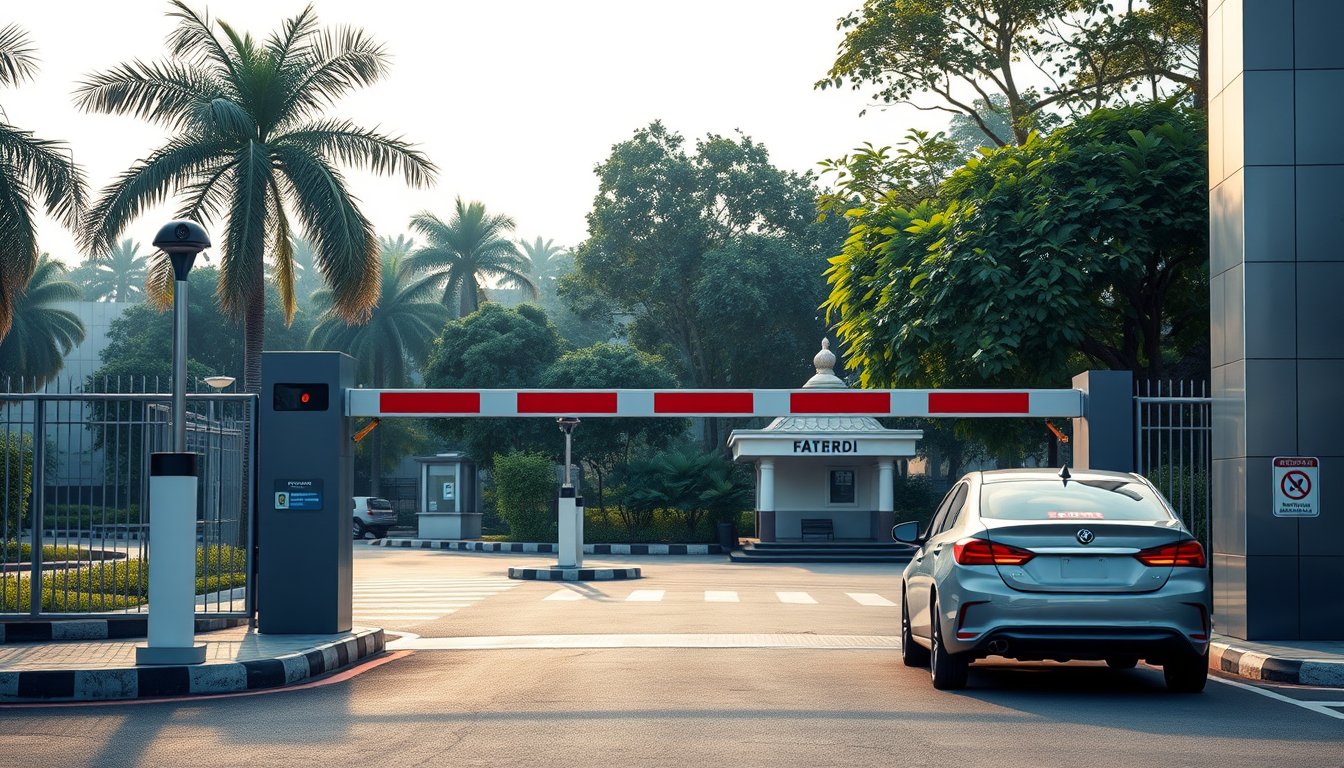
A 220-car office in Whitefield was losing eleven minutes every morning
Not to traffic on Old Airport Road. To its own gate.
A 12-year-old Godrej manual barrier, one security guard, a register, and a visitor token system built on WhatsApp. At 8:40 am the queue stretched back to the compound wall. Peak throughput was roughly 95 cars an hour — about 11 minutes of cumulative delay per employee who arrived between 8:30 and 9:15. Finance worked out that the lost productive time, valued conservatively, cost more per month than a proper boom barrier installation would cost once.
That is the honest reason most Bangalore companies call us about boom barriers. Not because the gate looks tired. Because the gate is a bottleneck that shows up in payroll.
Boom barrier installation in Bangalore is a crowded, messy market. You will get quotes ranging from ₹38,000 to ₹4.5 lakh for what sounds like "the same barrier". This article explains what actually differs — RFID versus ANPR versus manual, what throughput each delivers per lane, why safety loops are not optional, and how the barrier has to talk to your parking and visitor management systems. It also includes the failure story of a deployment we inherited and fixed, with numbers.
If you want to skip to the final service scope, our security and surveillance practice covers barrier, CCTV, access control and integration as one system.
What a boom barrier actually is (and is not)
A boom barrier is a motorised arm that raises and lowers to control vehicle entry. That is the full mechanical definition. Everything interesting happens around it. The barrier itself is roughly 20% of the project cost and 5% of the operational headache.
The rest is:
- The vehicle identification method (RFID tag, ANPR camera, manual, or a hybrid)
- The safety system (induction loops, infrared curtains, anti-crush sensors)
- The controller logic (how it decides when to open, hold, and close)
- The integration layer (parking management, visitor management, HRMS, ERP, sometimes payroll for contractor billing)
- The power and cabling design (because Bangalore monsoon and gate-area earth pits are not friendly)
- The civil work (loop cutting, bollard foundations, cable trenching, drainage)
A "boom barrier" bought off IndiaMART for ₹28,000 is just the first bullet. It will work for a 40-car factory gate with one guard. It will fail badly at a 300-car tech park with a 90-second peak window.
RFID vs ANPR vs manual: the real comparison
This is the decision that determines everything downstream. Here is the honest comparison, with throughput numbers from deployments we have supported in Bangalore and the surrounding industrial belt.
Lane throughput per hour (single lane, trained operator)
| Access method | Cars per hour (typical) | Cars per hour (best case) | Typical read failure rate |
|---|---|---|---|
| Manual (guard + register) | 80–120 | 180 | Not applicable (human) |
| RFID long-range (UHF, 6–8m) | 380–520 | 600 | 0.3–1.2% |
| RFID short-range (HF, 1m, tap) | 180–260 | 320 | 1–3% |
| ANPR / LPR camera | 220–380 | 480 | 2–7% (Bangalore plates, rain) |
| Hybrid RFID + ANPR fallback | 380–520 | 600 | <0.2% |
| QR code (mobile) | 140–220 | 280 | 4–10% |
The spread matters. A single RFID lane replaces roughly three manual lanes at a busy ingress. That is the arithmetic that justifies the spend in a 200+ car facility.
Cost comparison (2026 pricing, Bangalore, single-lane)
| Component | Manual | RFID | ANPR | Hybrid |
|---|---|---|---|---|
| Barrier mechanism (e.g. Godrej / FAAC / Came) | ₹38,000–₹65,000 | ₹55,000–₹95,000 | ₹55,000–₹95,000 | ₹55,000–₹95,000 |
| Controller | Included | ₹18,000–₹32,000 | ₹22,000–₹38,000 | ₹35,000–₹55,000 |
| Reader / camera | ₹0 | ₹22,000–₹48,000 (UHF reader + antenna) | ₹32,000–₹85,000 (ANPR cam + IR) | ₹50,000–₹1,10,000 |
| Tags / cards (200 vehicles) | ₹0 | ₹28,000–₹60,000 | ₹0 | ₹28,000–₹60,000 |
| Safety loops + IR curtain | ₹0 | ₹12,000–₹22,000 | ₹12,000–₹22,000 | ₹12,000–₹22,000 |
| Civil + cabling | ₹8,000–₹15,000 | ₹22,000–₹40,000 | ₹22,000–₹40,000 | ₹25,000–₹45,000 |
| Integration (parking/visitor software) | ₹0 | ₹25,000–₹75,000 | ₹25,000–₹75,000 | ₹40,000–₹1,20,000 |
| Total single lane | ₹46,000–₹80,000 | ₹1.7L–₹3.6L | ₹1.7L–₹3.8L | ₹2.4L–₹4.8L |
| 5-year TCO (200 cars) | ₹2.4L–₹3.6L (mostly manpower) | ₹2.2L–₹4.3L | ₹2.2L–₹4.5L | ₹2.8L–₹5.5L |
A note on the manual column's total cost: the mechanism is cheap, but a guard post at ₹22,000–₹28,000 per month (2026 Bangalore rates for trained security) is ₹13–17 lakh over five years. The manual option looks cheap on the invoice and expensive on the payroll.
When clients ask us which they should pick, we ask three things — not one:
- Is the vehicle population fixed or open? A 250-employee office with a stable parking roster suits RFID. A mall, hospital, or airport-adjacent facility with unpredictable daily visitors needs ANPR or a hybrid.
- Do you need a trail? RFID gives you an auditable, timestamped record per lane. Manual gives you a guard's handwriting. If DPDP compliance or a client audit matters, this decides it.
- How bad is the gate? Bangalore gate areas often have low canopies, glare, dust, and 5–6 months of rain. ANPR accuracy in these conditions degrades faster than vendors admit. RFID does not care about weather as long as the tag is on the windshield.
The unpopular opinion on ANPR
ANPR is a great technology and is oversold as a default. At a Bangalore tech park with a clean, covered, well-lit approach lane and 8–10 metre line-of-sight, a quality ANPR camera (Hikvision iDS-2CD7A46G0 or Axis P1455-LE with LPR licence) can hit 96%+ read accuracy after tuning. At a warehouse gate on Nelamangala with a dusty approach, harsh afternoon sun, and a 25° entry angle, the same camera will drop to 78–84% on a wet day. That is not a product failure. It is a site design failure that most installers ignore because ANPR sounds more modern in the proposal.
My guideline: if you cannot get the camera at 3.5–5.5 metres height with a 15–30° horizontal angle to the plate and a clean 8m approach, do not lead with ANPR as the primary credential. Use it as a fallback on top of RFID. This is the hybrid column in the table above, and it is what we recommend for ~65% of the Bangalore deployments we see.
Safety loops: where cheap installs actually kill people
This is the part most clients pay for reluctantly, and it is the part you must not skip.
A boom barrier operates a heavy arm with 60–100 Nm of torque. Without detection underneath, the barrier will close on a car or a person. The 2018 amendments to the relevant BIS guidance on powered barriers and the widespread adoption of the NHAI style safety norms for toll plazas have made this clearer for public infrastructure. Private facilities are less regulated. Many are less safe.
Standard safety loop design for a single lane:
- Arming loop — detects an approaching vehicle, signals the controller to wake up and read credentials early. Positioned 4–6m before the barrier.
- Safety loop — under the barrier arm itself, detects a vehicle still crossing. Holds the arm open until the loop clears.
- Reset loop — past the barrier, confirms the vehicle has fully exited so the arm can close.
Plus, for any high-traffic or public-facing gate, an infrared anti-crush sensor across the barrier line (Came DIR-10 or equivalent) as a secondary check. And the barrier mechanism should include an anti-crush motor clutch — every Came, FAAC and NICE unit sold in India does. Some of the ₹28,000 Chinese imports do not.
Loop installation is civil work, not IT work. The slot is cut 40–60mm deep, wire is laid in a loop pattern, sealed with epoxy resin, cured, and then the surface is restored. Done badly, a loop will fail in two monsoons because water seeps under the seal. Most of the callbacks we receive on installations done by other vendors are loop failures in the 3rd or 4th year.
Cost of doing it properly: ₹12,000–₹22,000 per lane (2026). Cost of a loop failure on a live site: ₹8,000–₹15,000 to reopen the concrete, plus a day of lane closure, plus the alternative of a guard standing there for a week. The math is not close.
Throughput per lane: how to actually size the number of barriers
Most clients underestimate this. The rule of thumb for a single lane:
- RFID at 6–8m read distance: ~450 cars per hour peak, ~300 sustained
- ANPR: ~320 cars per hour peak, ~240 sustained
- Manual: ~100 cars per hour peak
- Pedestrian mixing (if pedestrians cross the vehicle lane): subtract 40%
Peak hour demand at a Bangalore office with 600 staff and 220 cars, where 70% arrive between 8:30 and 9:30:
- 154 cars must clear in 60 minutes = 154 cars/hour
- One manual lane handles it. Barely. With queue spillover onto the road.
- One RFID lane handles it at 35% of capacity. Comfortable margin.
- One ANPR lane handles it at 48% of capacity. Fine in dry weather, tight in rain.
Now a 1,200-staff IT campus on Sarjapur Road with 450 cars and a shift change that puts 320 cars on the gate in 45 minutes:
- 320 cars/45 minutes = 427 cars per hour
- One RFID lane: close to capacity. Not enough buffer.
- Two RFID lanes: each at ~48% load. Right-sized.
- One ANPR lane: cannot handle this. Peak will queue onto the road and draw BBMP attention.
We size one lane for every 200–250 cars of peak inflow if entry spacing is tight. Two lanes for every 500. Beyond that, the barrier itself is no longer the constraint; you need stacking space, drop-off lanes and pedestrian segregation.
Integrating with parking, visitor and HR systems
A barrier with a reader is a demo. A barrier that talks to your parking management system, visitor management, HRMS, and access control is a system. The gap between the two is where most Bangalore installers fall over.
What integration usually involves
- Parking management software (Skidata, Zeel, Park Assist, or a domestic vendor like Sprocket / ParkEase): issues ticket, assigns slot, controls barrier arm, handles monthly passes, reconciliation with finance.
- Visitor management (Paxinet, VisitorApp, or your own custom portal): pre-registration by host generates a QR code or OTP for the visitor, which the barrier accepts on arrival. Eliminates the paper register at the visitor gate.
- HRMS (Darwinbox, Keka, GreytHR): blocks barrier access for terminated employees, taxi vendors, and expiring contractor passes. Automated, not manual.
- Access control (Honeywell, Matrix, HID): allows the same SIM card or RFID card to work across the pedestrian turnstile, lift lobby, and café checkout (a real workflow at some corporates).
What integration actually costs and breaks
Budget ₹25,000–₹75,000 per site for integration labour (2026), depending on the complexity of your parking software stack. This is almost entirely labour, not product. The parking vendor's API is usually fine; the edge cases are around what happens when the parking server is down, or when the barrier controller loses network.
Design rule: the barrier controller must be able to operate autonomously on the RFID reader for at least 4 hours if the parking server is unreachable. If it can't, a network blip at 9:15 am produces a manual-only morning. We specify this explicitly in every tender. Most vendor quotes do not mention the offline mode at all.
A specific failure we inherited
A 320-unit residential community on Bannerghatta Road moved to a new boom barrier in early 2024. The vendor was the lowest bidder. RFQ was executed by the residents' welfare association with the correct intent — clean, safe, fast.
The system was deployed in March 2024. Three problems emerged:
- The RFID readers were short-range (1m HF) but pitched as long-range. Residents had to stop, roll the window down and tap the card on a reader post. Throughput was worse than the previous manual guard — about 180 cars per hour on peak mornings, with a queue that reached the main road.
- The safety loop was cut but not sealed correctly. In July 2024, after three weeks of monsoon, the loop in lane 1 failed. The barrier was then operated manually by a guard with a key for 19 days while the vendor and the RWA argued over who was responsible for the civil work.
- The barrier arm had no anti-crush detection on the closing side. In September 2024, a car with a bike rack on the rear was entering behind another vehicle. The barrier arm clipped the bike rack. Damage: ₹48,000 to the car, plus an insurance dispute, plus a viral residents' WhatsApp thread.
The RWA's total cost by October 2024: ₹2.3 lakhs on a system that should have cost ₹1.6 lakhs for the right design, plus a lane closure of 19 days, plus reputational damage with the resident committee.
What we did, at the RWA's request:
- Replaced the HF readers with long-range UHF (Impinj Speedway R420 readers with Laird antennas, 6–8m read at the ring position), which cost ₹92,000 for the two lanes.
- Re-cut and properly sealed all safety loops with a self-levelling epoxy rated for wet exposure (₹18,000 per lane).
- Added an infrared curtain across the barrier line (Came DIR-10, ₹9,800 each side).
- Rewired the controller into the gatehouse switchboard on a separate circuit with a 2kVA online UPS (APC SRV2KIL) for the barrier and reader stack.
Peak throughput went from 180 to 410 cars per hour. The morning queue stopped reaching the main road in three weeks. No loop failure since, through two monsoons.
We did not sell the RWA anything they did not need. We did not replace the barrier arms themselves — the Came units they had were fine. The lesson is not "buy premium". The lesson is "wrong access method, wrong loop civil work, missing anti-crush, and no UPS — that is what cheap buys you".
Power, network and monsoon: the Bangalore-specific bits that break installations
A few operational realities matter here more than in other Indian cities:
Power
Gatehouses and perimeter posts are almost always on their own circuit, often unmetered, often on the building's essential-services DB. A barrier motor needs a clean supply for the motor controller logic. Spurious resets and "the barrier opened on its own" are almost always the controller rebooting during a voltage dip. Put the barrier controller and reader power on a small 1–2 kVA UPS. Cost: ₹18,000–₹32,000 (2026). Non-negotiable.
ISP and cabling
If your gate barrier connects back to an internal parking server, you need cabling from the gatehouse to the MDF or a local IDF. BESCOM and BBMP permissions for crossing footpaths or cutting roads can take 3–8 weeks. Plan for that. If you are using a broadband link from Airtel or ACT to connect the gatehouse, new connection lead times in Bangalore area are 7–21 days for Airtel, often faster for ACT. Keep a 4G failover router (Teltonika RUT240 or similar) at the gate; ₹8,000–₹14,000.
Monsoon
Cable entry to outdoor reader posts must be sealed with proper glanded entry points. Every year we are called to gatehouses where the reader post has filled with water. The RFID reader itself is IP65-rated; the reader post is not, if it was installed by someone who thought silicone sealant was enough. Use proper cable glands, drip loops, and seal entry from the bottom, not the top.
If the loop is in a low-lying area near the gate, water pooling on the loop will stress the seal. Add a drain line as part of the civil work. This adds ₹4,000–₹8,000 per lane.
GST
Boom barrier installation services, when bundled with the material as a works contract, are taxed at 18% GST in Karnataka. Pure service contracts (AMC, support) are also 18%. No 12% or 28% category applies to boom barriers. If a vendor quotes 12% GST, that is a red flag on their compliance.
DPDP obligations
If your barrier system collects ANPR plate images or RFID tag numbers associated with named employees, you are processing personal data under the DPDP Act 2023. Practical implications: retention policy (do not keep plate images beyond 30–60 days unless there is a legal basis), consent notice to employees, and a data processing agreement with any vendor whose software processes it. Not required for a purely manual register, but required the moment you move to RFID or ANPR at scale.
What to specify in your RFQ
The tenders we see that succeed have the following in them. The ones that go wrong usually miss #3 and #6.
- Access method and read distance, stated in metres.
- Barrier make and model — insist on named models (Came G4040EZ, FAAC 620, Godrej BARR-6, NICE WIL4) rather than "branded barrier".
- Safety loop specification — number of loops, loop pattern, resin make, curing time.
- Anti-crush sensing — motor clutch (yes/no), IR curtain (yes/no, model).
- Controller offline mode — number of hours it must operate without network.
- Integration test plan — how the system will be validated against your parking and visitor software, with acceptance criteria on throughput and read rate.
- Power protection — UPS size and runtime.
- Monsoon and drainage plan for the civil work.
- DPDP data handling — retention, deletion, vendor DPA.
- AMC scope for years 1–3 — what is covered, response time, parts included or not.
If you want a starting point, our security and surveillance service page has the standard scope we quote against, and you can also talk to our team directly if you want a site visit before finalising anything.
Where RFID is the wrong choice
We recommend RFID for ~65% of the sites we quote. It is wrong in roughly a third of cases:
- Visitor-heavy facilities. Malls, hospitals, hotels, sports clubs. Visitors do not have tags. ANPR + QR code (with pre-registration portal) is a better primary. RFID becomes the resident or staff tier.
- Mixed-traffic industrial sites. Where trucks, tempos and two-wheelers use the same lane. UHF RFID on a two-wheeler needs a different tag orientation and antenna placement. Often it is simpler to segregate two-wheelers physically.
- Sites with very low vehicle volume (under 60/day). A manual barrier with a well-trained guard is cheaper and more flexible. We do not push an RFID system on a 40-car facility with two deliveries a day.
- Sites with no IT support and no interest in maintaining software. RFID requires an inventory of tags, an issuer, and someone to replace lost tags. If that owner does not exist inside your team, a simpler system wins.
Honest fit matters. We would rather lose the deal than install RFID on a site that will resent it in six months.
How the barrier talks to the rest of your security stack
The barrier should not be a stand-alone island. It sits inside the site security architecture:
- CCTV: an overview camera covering the barrier, plus a plate capture camera if you are running ANPR, plus a rear-exit camera. Standard Hikvision or Axis 4MP IP dome, ₹18,000–₹32,000 per camera installed (2026). Recorded to an NVR with 30-day retention.
- Access control: the same RFID card should be usable for pedestrian entry at the turnstile and lift lobby. Honeywell or Matrix controllers, ₹4,500–₹8,000 per door (2026).
- Video management: ANPR events and barrier events should be time-synchronised with VMS (Milestone XProtect, Hikvision iVMS, Axis Camera Station) for incident review.
- Alarm integration: forced-lift or arm-break events on the barrier should trigger a security alarm, not just an LED on the controller.
A barrier that works in isolation is fine until the day you need to prove a vehicle entered at a specific time. Then you need the video, the event log, and the visitor register to line up. Design for that day.
Maintenance: the annual cost nobody quotes
Annual maintenance on a boom barrier — motor service, loop test, reader firmware, integration check, edge case review — typically costs 6–9% of the installed system value per year (2026). For a ₹2.5 lakh single-lane deployment, that is ₹15,000–₹22,500/year.
The temptation is to skip the AMC in year 2 and 3 and only call someone when it breaks. In our experience, that produces a 3-year cumulative cost higher than the AMC — usually because a motor bearing failure and a loop failure happen in the same quarter as a reader failure, and each is a separate emergency callout at 2x the AMC rate.
Also, do not skip the annual loop test. A small electrical drift in a loop is easy to fix in a 20-minute visit. It is much harder once it has been silently failing for a year and one morning the barrier closes on a car and then you have a damage claim.
Getting a realistic quote in Bangalore
Three things shape the price you get more than anything:
- Number of lanes and whether you need redundancy.
- Access method and integration depth.
- Civil work scope — do you need trenching and road cutting, or is the barrier on a finished paved surface?
A realistic, well-executed single-lane RFID installation in Bangalore in 2026 is ₹1.7L–₹3.6L. A hybrid RFID+ANPR is ₹2.4L–₹4.8L. Multi-lane deployments drop the per-lane cost by 12–18% because the integration and controller stack is shared. A manual barrier with a proper guard post is ₹46,000–₹80,000 plus manpower.
Watch for quotes significantly under these ranges. They usually hide a short-range reader pitched as long-range, no UPS, no IR curtain, or an integration line item that turns out to be a change order once the system is half-installed.
FAQ
How long does boom barrier installation take in Bangalore?
A single lane with existing civil works takes 3–5 working days. If loops need cutting, trenching is required, or ISP coordination is needed, plan 10–15 working days. Multi-lane deployments run 2–3 weeks. Add 3–8 weeks if BBMP permission is needed for footpath excavation.
What does a boom barrier cost in Bangalore in 2026?
A manual barrier is ₹46,000–₹80,000 per lane plus guard manpower. A proper RFID installation is ₹1.7L–₹3.6L per lane. ANPR is similar. Hybrid RFID + ANPR is ₹2.4L–₹4.8L. Integration with parking or visitor management adds ₹25,000–₹75,000 per site.
RFID or ANPR — which is better for my office?
RFID for stable employee vehicle populations with a dedicated lane. ANPR for visitor-heavy sites or where tags would be impractical. Most Bangalore sites we deploy run hybrid: RFID as primary, ANPR as fallback. If the approach lane is short or has difficult lighting, do not lead with ANPR.
Can the barrier integrate with my existing visitor management system?
Yes, if your visitor management product exposes an API. Paxinet, VisitorApp, and custom portals usually do. Confirm the integration with a 1-day pilot before signing. Barrier-to-parking integration typically takes 5–10 working days of developer time.
What happens to the barrier during a power failure?
Properly designed installations have a UPS for the controller and reader, and a manual release key on the barrier motor. Without a UPS, the barrier loses position and requires a manual reset on power return, which is where morning queues come from.
Is the barrier safe if a person walks under it while closing?
The safety loop and infrared curtain detect a vehicle, not always a person. Pedestrian safety requires an anti-crush clutch on the motor and, for sites with pedestrians crossing the vehicle lane, a separate pedestrian gate or turnstile. Do not rely on the loop alone for pedestrian safety.
Next step
If you are evaluating boom barrier installation in Bangalore and want a site visit before committing — not a brochure, an honest measurement of your approach lane, power quality, and integration feasibility — talk to our team. Bring your current gate statistics: peak hour vehicle count, peak window, and what parking or visitor software you already run. We will tell you which access method actually fits, and we will say no if a barrier is not the right answer for your site. That is the whole point.