
Fire Alarm Integration with Access Control: Fail-Safe Release, NBC Rules and Testing
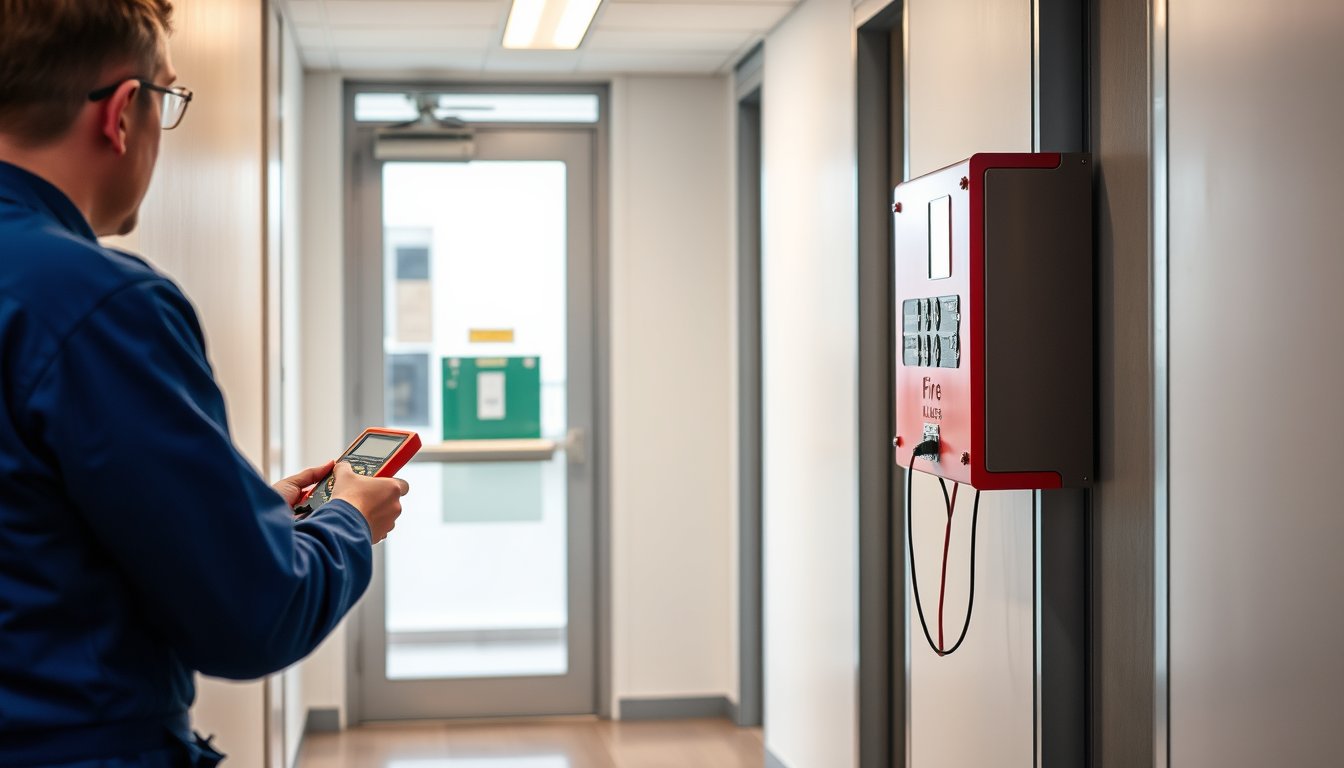
The door that stayed locked
In March 2024, a 90-person IT services firm in Bengaluru's Indiranagar had a small electrical fire in a first-floor server room. The fire alarm panel tripped. Staff evacuated. The fire was out within eleven minutes — the damage was limited to a UPS and a wall panel. But two employees were briefly trapped behind a maglock door on the second-floor corridor because the access control system had no fire-release relay wired in. The door reader had power. The lock had power. The fire panel had signalled. Nothing happened. The office manager later told us the installer had said "the fire panel and access control are separate systems, madam, don't worry."
That incident cost the firm ₹1.4 lakh in emergency electrical repairs and another ₹60,000 in lost billable hours. The fix — a single fire alarm relay interface to the access controller's fire input, plus a 12V 7Ah battery-backed power supply — cost ₹18,500 in parts and labour. The firm spent more on the post-incident compliance review than on the correction.
This is the single most common integration failure we see across the 1200+ organisations SynergyScape has supported since 2001. Access control is bought as a security system. Fire alarm is bought as a life-safety system. They are installed by different vendors, on different budgets, often in different years. And the one wire that connects them — the one that decides whether a door unlocks or stays shut when the alarm sounds — is left out.
If you are evaluating fire alarm integration with access control for an Indian office, this article covers the engineering, the National Building Code requirements, the local fire NOC expectations, the testing routine, and the documentation a fire officer will actually ask to see. It is written for the IT manager or operations head who will sign the purchase order, not for the systems integrator who already knows.
What "integration" actually means at the door
Fire alarm integration with access control is not a software feature. It is a physical and logical link between two controllers that were designed by different manufacturers for different purposes. There are four ways to make that link, and only three of them are acceptable in a life-safety context.
The fire alarm relay
Most commercial fire alarm control panels — Honeywell Morley, Edwards EST, Bosch, Notifier, Ravel, Apollo — provide one or more programmable relay outputs. These relays can be configured to change state when the panel enters alarm condition. A normally-open relay closes on alarm; a normally-closed relay opens. The access controller has a dedicated fire input (sometimes labelled FIRE, sometimes IN-3, sometimes an auxiliary input) which, when triggered, drops power to the lock circuit.
This is the correct, code-compliant method. It does not depend on software, network, or the access control server being online. It works when the network is down, when the server is off, and when the access controller has lost its configuration. It is also the method most commonly omitted, because it requires the fire alarm vendor and the access control vendor to coordinate during commissioning — and they rarely do unless someone forces the meeting.
The dry contact from the access controller
Some access controllers (Honeywell Win-Pak, HID VertX, Suprema BioStar, Matrix COSEC) have a dedicated fire alarm input terminal. You wire the fire panel relay dry contact directly to this terminal. The controller firmware then handles the release logic, typically by dropping lock power on all doors in the group. This is the same as the relay method at the electrical level, just terminated at the controller rather than at a power supply. It is fine, but you must confirm the controller's fire input is electrically isolated and that it does not depend on a heartbeat from the server.
Software integration
Some access control platforms (Genetec Security Center, Milestone XProtect Access, Avigilon Control Center) can receive fire alarm events over a network connection from a fire panel that supports IP reporting, or from a third-party integration module. The software then sends a release command to the door controllers.
This is the least reliable method for life safety. It depends on the network, the server, the integration module licence, and the software configuration remaining intact. We have seen it work perfectly in a lab and fail on site because a firewall rule blocked UDP port 5001 between the fire panel and the access server. Use software integration for reporting and dashboarding. Never use it as the primary release mechanism.
The interlock with the door hardware
There is a fourth element that most Indian installations miss: the door hardware itself. A maglock (electromagnetic lock) is fail-safe by design — it releases when power is removed. An electric strike can be fail-safe or fail-secure depending on the model. A motorised lock (like the Assa Abloy ML-series) is typically fail-secure. If your door has a fail-secure lock and the fire release only drops controller power without dropping lock power, the door stays locked. The fire relay must drop power to the lock circuit, not just signal the controller.
Best practice: a dedicated 12V or 24V DC power supply for lock circuits, with a fire relay in series on the output. When the relay opens, lock power drops. No controller, no software, no network. Just physics.
What NBC 2016 actually says about egress and access control
The National Building Code of India 2016, Part 4 (Fire and Life Safety), is the governing document for fire safety in commercial buildings. It is not advisory. It is referenced by state fire departments, and fire NOC inspections in Karnataka, Maharashtra, Tamil Nadu and most other states test against it.
The relevant clauses
Clause 4.2.2.1 requires that exits be arranged so that they are always accessible and unobstructed. Clause 4.6.1.3 states that doors in the means of egress must be openable from the inside without a key or special knowledge. Clause 4.6.1.4 permits electromagnetic locking devices only where they release automatically upon activation of the fire alarm system, and where a manual release (a break-glass or push-button) is provided within 1.2 metres of the door.
For an access-controlled door on an egress route, this means three things:
- The door must release automatically when the fire alarm activates. Not on a timer. Not after a server heartbeat. When the alarm sounds.
- A manual release must be provided. This is usually a green break-glass unit or a push-button mounted next to the door, at 900–1200 mm height, clearly labelled. In Indian practice, the green break-glass is more common and more familiar to staff.
- The door must remain openable from the inside without a key. If your maglock drops power, the door is mechanically free. If you use a fail-secure lock or a strike that requires a key from the inside, you are non-compliant.
The fire NOC inspection
A fire NOC (No Objection Certificate) from the state fire and emergency services is required for most commercial buildings above a certain height or occupancy. In Karnataka, the Directorate of Fire and Emergency Services issues the NOC, and the inspection typically covers:
- Fire alarm panel with battery backup and logging
- Manual call points at every exit and on every floor
- Automatic detection in server rooms, electrical rooms, and corridors
- Access-controlled doors releasing on alarm
- Break-glass or manual release at each egress door
- Emergency lighting and exit signage
- Fire extinguishers and hose reels
- Documentation: as-built drawings, cable schedules, test records, and a commissioning certificate
The access control integration is one item on a long list. Fire officers in Bengaluru have become noticeably more thorough in the last three years, particularly after the 2022–2023 audits of tech parks and co-working spaces. A missing fire relay on a maglock door is an easy catch and a common one.
What is not required (despite what vendors say)
You do not need a separate fire-rated access control system. You do not need to replace your existing access controller. You do not need a proprietary integration module from your access control vendor. You need a relay, a power supply, a wire, and a commissioning test. The rest is sales.
The failure modes we actually see
We have audited access control installations across Bengaluru, Chennai, Hyderabad and Pune. The same mistakes appear in almost every site. Here are the four we see most often, and what they cost to fix.
The missing fire relay
Estimated frequency: 60–70% of small and mid-size offices we audit. The access control vendor installs the controller and locks. The fire alarm vendor installs the panel and detection. Neither is contractually responsible for the link. The link is absent.
Cost to fix: ₹12,000–₹25,000 per door group for the relay interface, power supply, wiring and commissioning. A 4-door deployment typically lands at ₹35,000–₹55,000 including labour and testing (2026 pricing).
The software-only integration
Estimated frequency: 15–20% of sites that do have an integration. The vendor has configured the access control software to listen for fire events over the network. The relay is not wired. On the day of the fire, the network is down, the server is rebooting, or the integration module licence expired. The doors stay locked.
Cost to fix: ₹18,000–₹30,000 to add the physical relay and re-commission. You do not need to remove the software integration — keep it for the event log — but it must not be the release path.
The fail-secure lock
Estimated frequency: 10–15% of sites, mostly older installations or those where the locks were specified by a security consultant who was not thinking about egress. The fire relay is wired correctly, the controller releases, but the lock is a fail-secure strike or a motorised lock that requires power to open. The door stays shut.
Cost to fix: ₹8,000–₹18,000 per door to replace the lock hardware, plus the cost of re-drilling the frame in some cases. Insurance may not cover this because it is a code violation at installation.
The unlabelled break-glass
Estimated frequency: almost universal. The break-glass is installed — good — but it is not labelled, not tested, and not mentioned in the staff induction. In an emergency, staff do not know it exists. We have seen people try to force doors open with their shoulders rather than use a break-glass that was 30 cm from their hand.
Cost to fix: ₹200 per label, ₹0 for the induction if you already have a safety briefing. This is the cheapest fix on the list and the one most often skipped.
A worked failure story: the four-door office that cost ₹1.2 lakh
A 50-seat digital marketing agency on Residency Road, Bengaluru, had a 4-door access control system installed in 2021: a Suprema BioStation 2 reader on the main door, a Suprema X-Station on the server room, and two maglock doors on the corridor leading to the terrace. The fire alarm system was a Honeywell Morley panel with heat and smoke detectors.
The access control was installed by a vendor who did not do fire alarm. The fire alarm was installed by a vendor who did not do access control. Both systems were tested independently and passed. The building fire NOC was issued in 2022 on the basis of a visual inspection that did not test door release.
In August 2024, a water heater in the pantry short-circuited, producing smoke that tripped a corridor smoke detector. The fire alarm sounded. Staff evacuated. The two maglock doors on the terrace corridor did not release. A team of five people was trapped between the terrace door and the server room door for four minutes until a facilities manager arrived with the physical override key. No one was injured. The incident was reported to the building management, who required a fire safety audit of all tenants.
The audit found no fire relay on the access controller, no break-glass at the two maglock doors, and no documentation of door release testing. The agency had to:
- Install a fire relay interface and a 12V 5A power supply for the lock circuits: ₹22,000
- Install two break-glass units: ₹4,800
- Re-commission and test all four doors: ₹9,500
- Replace one electric strike that was fail-secure: ₹14,000
- Produce as-built drawings and a test report for the building audit: ₹12,000
- Pay a penalty to the building management for non-compliance: ₹60,000
Total: ₹1,22,300, plus two weeks of management time. The original integration would have cost ₹28,000 at the time of installation in 2021. The agency's operations head put it plainly: we spent four times as much to fix a problem we did not know we had.
How to specify the integration correctly
If you are installing a new access control system or upgrading an existing one, the integration specification belongs in the tender or the purchase order, not in a verbal instruction to the vendor on commissioning day.
The specification language
Use language that is unambiguous and enforceable. Something like: "The access control system shall provide a fail-safe release of all electromagnetic locks on egress routes upon activation of the building fire alarm system. The release shall be via a hard-wired dry contact from the fire alarm panel to a dedicated lock power supply, independent of the access control server and network. A manual break-glass release shall be provided within 1.2 m of each egress door. The contractor shall provide as-built drawings, a cable schedule, and a commissioning test report signed by the fire alarm and access control vendors."
That paragraph is worth more than any product datasheet. It forces the two vendors to coordinate.
The bill of materials
A typical 4-door integration on an existing access control system needs:
| Item | Specification | Indicative cost (2026) |
|---|---|---|
| Fire alarm relay interface | Dry contact relay, 1 NO/1 NC, 24V DC coil, fire panel compatible | ₹2,500–₹4,500 |
| Lock power supply | 12V DC, 5A, battery backup, fire relay input | ₹4,500–₹7,500 |
| Break-glass units | Green break-glass, resettable, with sounder | ₹1,800–₹2,800 each |
| Wiring and conduit | 2-core 1.5 sq mm fire-rated cable, PVC conduit | ₹1,200–₹2,000 per door |
| Electric strike replacement (if fail-secure) | Fail-safe strike, 12V DC, ANSI 4-7/8" | ₹6,000–₹12,000 per door |
| Commissioning and testing | 2 engineers, 1 day, test report | ₹8,000–₹15,000 |
| Documentation | As-built drawings, cable schedule, O&M manual | ₹3,000–₹6,000 |
A 4-door integration on an existing system typically lands at ₹38,000–₹65,000 depending on whether locks need replacement. A new installation with integration built in from day one adds ₹25,000–₹40,000 to the access control project — significantly less than retrofitting.
The commissioning test
The test is simple and should be witnessed by you, not just by the vendor. The sequence:
- Confirm all doors are locked and the access control system is online.
- Activate the fire alarm panel using a manual call point or a test key on the panel.
- Confirm every maglock door on an egress route releases within 2 seconds. Use a stopwatch. If it takes longer, the relay is not wired correctly.
- Confirm the break-glass on each door also releases the door independently.
- Reset the fire panel. Confirm the doors re-lock and the access control system returns to normal operation.
- Repeat the test with the access control server powered off. The doors must still release. This is the test most vendors fail.
- Repeat the test with the network switch powered off. Same requirement.
- Record the results in a test report with date, time, door ID, release time, and signatures from both vendors.
If the vendor cannot perform step 6 and step 7, the integration is not compliant.
Testing and documentation: what a fire officer will ask for
Fire NOC inspections in Bengaluru and other Indian cities have become more evidence-based. The officer may not test every door, but they will ask for records. The documents you need:
The as-built drawing
A floor plan showing the location of each access-controlled door, the fire alarm panel, the relay interface, the power supply, the break-glass, and the cable route. It does not need to be a CAD masterpiece. It needs to be accurate and dated.
The cable schedule
A table listing each cable: from, to, type, length, and purpose. For the fire relay, the cable should be fire-rated (FR) or at least FRLS (fire-retardant low-smoke). In practice, many Indian installations use ordinary PVC cable. This is a finding in a strict audit. Use FR cable for the relay circuit, especially if it runs through a ceiling void.
The commissioning test report
The signed record of the test sequence above. Include the stopwatch readings. Include the server-off and network-off tests. Include the names of the witnesses. A one-page report per door group is enough.
The maintenance log
A record of the monthly test. Yes, monthly. The fire alarm system should be tested monthly (panel indicators, battery, call points on rotation). The door release should be tested at the same time. The log should show date, door, result, and the initials of the person who tested it. A fire officer who sees a monthly log with consistent entries is far less likely to dig deeper than one who sees an empty file.
The annual third-party audit
Some building managements and insurers require an annual fire safety audit by a third party. The audit should include the door release test. If your building does not require it, consider it anyway — the cost is ₹15,000–₹30,000 for a small office, and it catches problems before an inspection does.
Where the integration fits in your broader security stack
Access control is one layer of physical security. Fire alarm integration is the life-safety override on that layer. It sits alongside CCTV surveillance, video management, visitor management, and intrusion detection. If you are reviewing the whole stack, the security and surveillance services we deliver cover access control design, fire relay integration, CCTV, and the documentation package that fire NOC inspections require. The integration is not a separate project; it is a line item in the access control scope.
There is a trade-off worth stating honestly. If your office is in a leased building where the fire alarm panel is owned by the landlord, you may not have the authority to add a relay to that panel. In that case, the integration has to be negotiated with the building management, and the relay may need to be installed inside the landlord's panel by the landlord's fire vendor, with your access control vendor providing the interface. This is slower and more expensive — expect ₹15,000–₹25,000 in coordination costs — but it is the only compliant path. Do not let a vendor tell you the landlord's panel cannot be touched and then leave the doors locked.
FAQ
Is fire alarm integration with access control mandatory in India?
For buildings that require a fire NOC under the National Building Code 2016, yes. Part 4, Clause 4.6.1.3 and 4.6.1.4 require that egress doors open without a key and that electromagnetic locks release on fire alarm activation. For small offices that do not require an NOC, it is not legally mandatory but is strongly recommended and increasingly required by building management and insurers.
What is the difference between fail-safe and fail-secure?
Fail-safe means the lock releases when power is removed. Maglocks are fail-safe by design. Fail-secure means the lock stays locked when power is removed; it requires power to open. Electric strikes and motorised locks can be either. For egress doors, you must use fail-safe hardware. A fail-secure lock on an egress door is a code violation regardless of whether a fire relay is wired.
Can I integrate fire alarm with my existing access control system?
In most cases yes. If your access controller has a fire input terminal or your lock power supply can accept a dry contact relay, the integration is a matter of wiring and commissioning. The exception is very old or proprietary systems where the lock power is integrated into the controller and cannot be interrupted independently. In that case, you may need a new power supply for the lock circuits.
How much does fire alarm integration cost in Bangalore?
For an existing 4-door access control system, expect ₹38,000–₹65,000 (2026 pricing) for relay interface, power supply, break-glass units, wiring, commissioning, and documentation. If locks need replacement to fail-safe hardware, add ₹6,000–₹12,000 per door. A new installation with integration from day one adds ₹25,000–₹40,000 to the access control project.
How often should I test the door release?
Monthly, as part of the fire alarm test routine. Test at least one door group per month on rotation, and test all door groups quarterly. Record the results. The annual third-party audit should test every door.
What documents does a fire NOC inspection require for access control integration?
As-built drawings showing door locations and relay wiring, a cable schedule with cable types, a commissioning test report signed by both vendors, and a maintenance log showing monthly tests. Some inspectors also ask for the fire alarm panel commissioning certificate and the battery backup test record.
What to do next
Open your access control as-built drawing — if you have one — and count the doors on egress routes. Then walk to each door and check three things: is there a break-glass within 1.2 metres, is the lock a maglock or a fail-safe strike, and is there a cable from the fire alarm panel to the lock power supply. If any of those is missing, you have a compliance gap and a life-safety risk.
The fix is not expensive relative to the risk. A 4-door remediation is typically ₹40,000–₹65,000 including testing and documentation. The failure story above cost ₹1.2 lakh plus a penalty. The math is not close.
If you want a second pair of eyes on your installation, talk to our security team. We will walk the doors with you, test the release with the server off, and give you a written report you can take to your building management or fire officer. No obligation, no sales pitch — just the test results.