
IT AMC for Banks and Financial Institutions in Bangalore
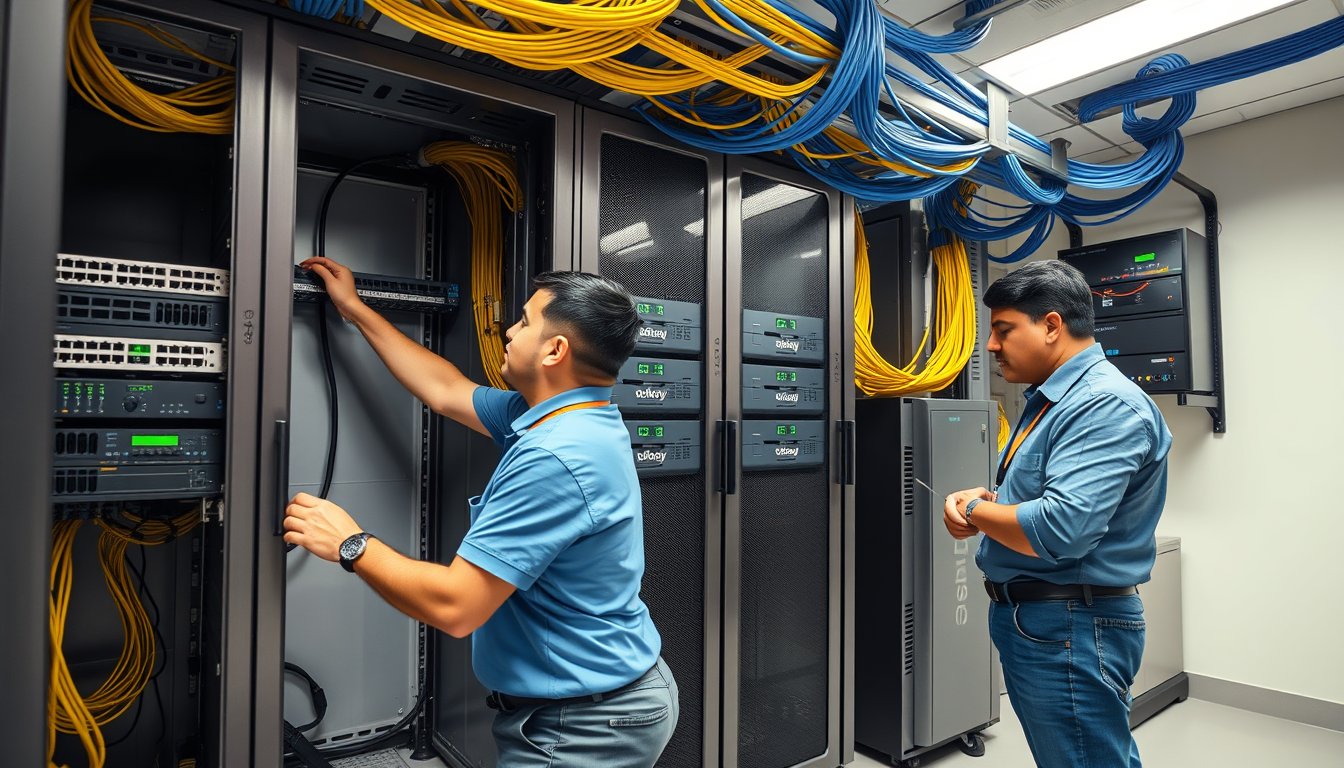
The ₹4.2 lakh afternoon at a Jayanagar cooperative bank
In March 2024, a 34-branch cooperative bank in Bangalore's Jayanagar area had a core banking server's RAID controller fail at 11:40 AM on a Saturday. Their IT AMC provider — a generic desktop-and-printer outfit from Koramangala — had a 24-hour response SLA written into a contract nobody in the bank's audit team had read carefully. The engineer arrived Monday morning. By then, the bank had run 47 hours on a degraded single-disk fallback, reversed ₹18.4 lakh in duplicate UPI settlements manually across three branches, and paid a courier ₹9,600 to physically move backup tapes to a recovery site because nobody had configured network-based backups.
Total cost including staff overtime, customer compensation (the bank waived ₹31,000 in fees to placate account holders who saw failed transactions), and the emergency controller replacement: ₹4.2 lakh. The bank's annual IT AMC spend had been ₹3.1 lakh.
The contract was technically compliant. The provider responded within 24 hours. What it did not do was promise that a qualified engineer would be at the branch by 2:00 PM that Saturday with a spare RAID controller in hand, because the contract never specified a spare-parts RTO (recovery time objective). It never specified a branch-level response time at all.
This is the gap between a generic IT AMC and one written for a bank. If you run or finance IT at a bank, NBFC, cooperative credit society, or payments company in Bangalore, this article is the practical version of the conversation you need to have before your next audit.
What makes IT AMC for a bank different from IT AMC for an office
A 200-seat software company and a 20-branch bank can have identical hardware bills and still need completely different AMC contracts. The difference is not the equipment. It is what happens when the equipment fails.
For a software company, a failed firewall means lost productivity. For a bank, a failed firewall during business hours means transactions do not clear, UPI settlement may breach TAT, customers can't withdraw, and the branch manager is on the phone to the regional office. For a bank with an ATM network, a failed ATM is a public failure that the RBI's customer protection framework treats as a service deficiency.
Three RBI instruments shape what your AMC must deliver:
- The Cyber Security Framework (CSF), issued in 2016 and refined through subsequent circulars, requires banks to have documented incident response procedures, defined RTOs and RPOs, and evidence that third-party service providers are monitored.
- The Digital Lending Guidelines (2022) add vendor accountability requirements for NBFCs and fintechs. If your IT AMC provider has access to your systems, they are a vendor in your register.
- The Master Direction on IT Governance (2023) makes the board responsible for IT resilience. Auditors in Bangalore now routinely ask for AMC contracts, vendor due-diligence records, and evidence of background verification.
A standard office AMC satisfies none of these. An RBI-aligned AMC is structured so that every SLA term, every engineer who touches your servers, and every change ticket leaves a trail your auditor can follow.
The four AMC components a bank's auditor looks for
1. SLA definitions that are branch-specific, not head-office-average
Most IT AMC contracts in India specify one response time — usually "4 business hours" or "next business day" — for the entire organisation. That is fine for an office. It is meaningless for a bank with branches in Jayanagar, Yelahanka, Whitefield, Electronic City, and Kengeri.
A branch at Electronic City is 26 km from a Hebbal-based engineer during peak traffic. On a Monday morning, that is 90 minutes minimum. If the contract says "2-hour response", the provider is technically in breach before the engineer leaves the parking lot. Branches know this, and providers know branches know it, so the SLA gets quietly ignored.
What an RBI-aligned AMC does instead: it defines response times per branch cluster, with engineer geographic staging. Our own SLA structure for Bangalore banks in 2026 looks like this:
| Branch zone | On-site response (critical) | On-site response (high) | Staging engineer location |
|---|---|---|---|
| Core South (Jayanagar, JP Nagar, Banashankari, Basavanagudi) | 60 minutes | 4 hours | Jayanagar depot |
| East (Whitefield, Marathahalli, Indiranagar, Koramangala) | 90 minutes | 4 hours | Whitefield staging |
| North (Hebbal, Yelahanka, RT Nagar, Jakkur) | 90 minutes | 5 hours | Hebbal office |
| West (Rajajinagar, Vijayanagar, Kengeri, Magadi Road) | 2 hours | 6 hours | Rajajinagar sub-depot |
| Far periphery (Anekal, Devanahalli, Hoskote) | 4 hours | Next business day | Bangalore office dispatch |
These are quoted from our actual 2026 contracts. A generalist AMC provider will quote "4 hours pan-Bangalore" because they cannot staff sub-depots. The difference in monthly cost is real — roughly ₹1,200-₹2,400 extra per branch — but the difference in business interruption is much larger.
2. ATM and kiosk uptime with financial penalty clauses
An ATM that is down for 8 hours is not the same as a desktop that is down for 8 hours. The RBI's 2021 circular on ATM cash-out and failed transactions requires banks to pay customer compensation for ATM failures above specified thresholds. For a bank running 40 ATMs across Bangalore, a 2% monthly uptime shortfall costs more in customer compensation than the entire ATM AMC line item.
A bank-grade ATM AMC must therefore contain:
- Uptime commitment — typically 98.5% per ATM per month (we do not recommend anything below 98%) and 99.5% for cash-recyclers at high-traffic locations.
- First-line vs second-line response split — a trained first-line response within 30 minutes (remote or dispatched), with second-line on-site within 2 hours.
- Financial penalty — a percentage of monthly AMC fee deducted per ATM per percentage point of shortfall, capped at 50% or similar. We've seen contracts with a 30% penalty cap that still cost the bank less than one weekend of ATM downtime.
- Spare cash-cassette and dispenser modules — held at the AMC provider's Bangalore depot. For NCR and Diebold Nixdorf ATM fleets, common to Indian banks, dispenser module failures are the most expensive downtime cause and the module is not stocked by every provider.
3. Audit trails from the engineer's first touch to the last
RBI's Master Direction on IT Governance (2023) requires banks to maintain logs of privileged access and changes to critical systems. If your AMC engineer logs into a core banking-adjacent server to replace a disk, that is a privileged access event and must be logged, attributable, and reviewable.
What does this mean in practice for your AMC?
- Every engineer must have a named, individual login (not a shared
adminorsupportaccount). - Every session on a production server must be recorded or logged through a PAM (privileged access management) tool — we commonly deploy ManageEngine PAM360 or CyberArk for banks in Bangalore.
- Every change ticket must contain: the change description, the approver's name, the engineer's name, the start time, the end time, the rollback plan (even if unused), and a post-change verification.
- The AMC provider delivers a monthly change log to your IT security officer, and quarterly to your IS audit committee.
A generic IT AMC will not know what you mean by "privileged access log." A bank-grade AMC has this as a line item in its monthly report.
4. Background-verified engineers — with a documented verification chain
The single most commonly missing element in IT AMC contracts for Indian banks is documented background verification of the engineers who will enter your branches. RBI's outsourcing guidelines (2023) require banks to ensure that vendor personnel with access to bank premises and systems are appropriately screened.
A yes/no certificate from the AMC provider is not enough. Your auditor will want to see:
- Police verification certificate per engineer, less than 18 months old
- Prior-employment verification (last two employers, minimum)
- Education certificate verification against the issuing university
- Address and identity verification (Aadhaar and PAN copies are standard)
- A signed confidentiality and non-disclosure agreement tied to your bank's data
- A declared list of all engineers who will visit branches, updated quarterly
We maintain this as a standing register for our banking clients and refresh it every 12 months. It is not a differentiator in a sales pitch; it is table stakes. If your incumbent provider cannot produce this file on 48 hours' notice, that alone is grounds to renegotiate.
What a bank-grade IT AMC should cost in Bangalore (2026 pricing)
The honest answer is that it varies more than for offices, because the SLA tail and compliance overhead dominate the calculation. Here is what we quote in Bangalore in 2026 across different bank sizes:
| Bank / NBFC profile | Users | Branches | AMC scope | Annual AMC (₹, 2026) |
|---|---|---|---|---|
| Single-branch cooperative credit society | 15-25 | 1 | Endpoints, network, server, UPS, basic firewall | ₹68,000-₹95,000 |
| Small urban cooperative bank | 40-60 | 2-3 | Above + PAM logging, quarterly audit pack, background-verified pool | ₹1.9-2.9 lakh |
| Mid-size NBFC (Bangalore HQ + 6 branches) | 120-180 | 6-8 | Above + ATM AMC (8 units), core-banking-adjacent server support | ₹6.5-9.2 lakh |
| Regional bank (20-30 branches in Karnataka) | 200-350 | 20-30 | Above + 24×7 NOC, on-site resident engineer at HQ, ATM AMC (30+) | ₹18-28 lakh |
| Multi-state bank with Bangalore regional office | 400+ | 10 (Bangalore) | Regional AMC, hub-and-spoke with bank's own IT team | ₹32-48 lakh |
These are annual figures. Add ₹45,000-₹70,000 per ATM per year for the ATM-specific component (first-line and second-line support, cash-cassette and dispenser spares at depot). Add ₹1.8-₹4.5 lakh per year if you want the AMC provider to produce your IS-audit evidence pack themselves rather than your internal team assembling it.
Where the cost goes — roughly, for a ₹4 lakh mid-size NBFC contract:
| Component | Share of contract |
|---|---|
| Engineer time (including travel and standby) | 38-45% |
| Spare parts pool and depot holding | 18-24% |
| Compliance, audit reporting, background verification refresh | 12-18% |
| Remote monitoring (RMM tooling, NOC) | 10-14% |
| AMC margin | 10-15% |
A generic AMC at ₹2 lakh for the same scope is 60% of that cost. It will still show up with a printer engineer. It will not hold spares, and it will not produce an audit pack.
The specific failure story that changed how we write bank AMCs
In September 2023, we were asked to take over a 12-branch Bangalore bank's AMC after an incident. The prior provider had skipped a critical firewall firmware update on the bank's perimeter FortiGate 100F because the update required a reboot and the change window had not been approved. Six months of queued firmware. When a vulnerability in the SSL-VPN component (CVE-2022-42475, publicly disclosed much earlier) was eventually exploited, an attacker used it to pivot to an internal application server and exfiltrate customer KYC documents covering 3,412 accounts.
Cost to the bank, all in:
- Incident response and forensics: ₹6.8 lakh
- Customer notification and credit monitoring: ₹2.4 lakh
- RBI scrutiny and audit remediation: ₹3.2 lakh internal cost
- Reputational damage and one large depositor moving ₹4 crore in deposits: not quantifiable but real
- Total remediation, including moving to a new AMC provider: ₹14.5 lakh in the first 6 months
The AMC provider had never had a change-approval workflow. Nobody in the bank approved firmware updates because nobody in the bank knew the AMC provider wanted to apply them. Neither party owned the patch cycle. That gap is what makes a bank AMC different from an office AMC: the office can reboot on a Saturday; the bank cannot, and so patches pile up unless the AMC has a documented, jointly-approved maintenance window schedule and the discipline to enforce it.
We fixed it with three concrete things, all now standard on our bank AMC contracts:
- A quarterly change calendar, signed off by the bank's IT head at the start of each quarter, with all firmware and OS updates pre-approved in principle and re-confirmed 48 hours before each window.
- A FortiGate high-availability pair on every branch firewall so that a reboot is non-disruptive. If you cannot afford HA on every branch, at minimum on branches with more than 15 concurrent users.
- A documented post-patch verification, signed by the engineer and countersigned by the branch manager, uploaded to the bank's audit file within 24 hours.
How SynergyScape handles bank and financial-institution AMCs
We have been doing IT infrastructure for Indian organisations since 2001, and financial services is now roughly 18% of our Bangalore book. We are not an RBI-registered cyber security auditor, and we are not a substitute for your IS audit firm. What we are is the operations layer between your audit obligations and the equipment that must keep working.
What that looks like in practice, and how it maps to the clients we currently serve:
- Branch SLA modelled geographically, matching the table earlier in this article, and written into the contract with penalty clauses.
- Background-verified engineer pool with an annual refresh and a quarterly register shared with the bank.
- Vulnerability and patch tracking with a change calendar owned jointly by our operations lead and your IT head.
- PAM logging (ManageEngine PAM360 or CyberArk, depending on scale) for every privileged access event on production servers.
- Monthly and quarterly reporting in a format your IS auditor can consume directly.
- 24×7 NOC at our Hebbal office, staffed by engineers we have employed directly, not a sub-contracted NOC in another city.
We do not quote this as a productised fixed price, because a 3-branch urban cooperative and a 30-branch regional bank are not the same shape. We quote after a site walkthrough, and we say so on the call.
Where our approach is not the right fit
Being honest about trade-offs is more useful than pretending everything is a fit. Here is where we tell prospective bank clients to go elsewhere:
- If you need SIEM-as-a-service or a managed SOC, we do not run one. Your IS audit will likely require this in addition to an AMC. Work with a specialist — we've partnered on projects with Sequretek, Tata Communications, and Sattrix and can introduce you.
- If your bank is fully outsourced to a core-banking vendor's own IT stack (some PSU co-op banking platforms include managed IT as part of the CBS licence), our AMC will duplicate spend. Check your CBS contract first.
- If you are a payments company processing more than 1 crore transactions per month, you need a specialist fintech infrastructure partner with dedicated SRE capacity. An AMC model, however well-executed, tops out at around 400-500 users of scope.
- If your leadership wants a fixed monthly fee with no site survey or audit mapping, we will quote it, but you will not get an RBI-aligned contract. The standard bank AMC requires 3-5 days of scoping work before a number can be honest.
- If your branches are outside Karnataka, we will only take the Bangalore region and coordinate with another provider elsewhere. We don't have staging depots in Chennai or Hyderabad, and pretending a Bangalore-based engineer can service a Mysore branch within a 2-hour SLA on a monsoon day is dishonest.
Network and power specifics for Bangalore bank branches
Banking environments in Bangalore have three operational realities that shape AMC design:
ISP lead times. A new BSNL or Airtel leased line at a Bangalore branch takes 4-7 weeks from order to live circuit, and 2-3 weeks longer if the branch is in an older commercial building in Chickpet or Avenue Road where the last-mile trenching requires BBMP approval. If your branch falls back to a 4G dongle during a primary circuit outage, the AMC must include the 4G failover hardware (a FortiGate 60F with dual-WAN failover is our usual quote, roughly ₹62,000-₹78,000 with installation in 2026), or the branch will be down for the full lead time. We now require secondary connectivity as a standard line item on every bank branch we onboard. It adds 4-6% to the AMC but eliminates a category of 3+ day outages.
Power reliability. Bangalore's power reliability has improved but branch UPS batteries degrade without being noticed. A flooded-cell UPS that has been in a branch for 4 years will fail on its first deep discharge, typically during the monsoon. AMC must include battery impedance testing every 6 months and battery replacement in the 3rd or 4th year, not as a separate purchase order. For a bank branch, the UPS being alive for 30 minutes after a power cut is the difference between a graceful branch close and a mid-transaction failure that has to be reversed manually.
Monsoon effects on branch cabling. Branches in older Bangalore buildings — the kind with asbestos roofs, exterior conduit, or run-through-the-basement cabling — will have cabling issues every July and August. Water ingress at the point where the conduit enters the wall, particularly on north-facing walls where the southwest monsoon rain hits sideways for hours, corrodes the copper in Cat6 runs and degrades PoE voltage for IP cameras. An AMC for a bank should include a pre-monsoon cabling inspection in May with documented findings and quotes for remediation. We include this without a separate line item; most providers don't. If your branch has exterior conduits you have not had inspected since last monsoon, that is a genuine risk.
GST treatment and the budget line item
IT AMC services provided to a bank in Bangalore are taxable at 18% GST under SAC 998313 (IT support services) or 998314 (IT infrastructure management services), depending on the exact scope. There is an important nuance that catches many banks:
- If the AMC provider's billing address and the bank's billing address are both in Karnataka, it is an intra-state supply — CGST 9% + SGST 9%.
- If the provider bills from outside Karnataka, it becomes an inter-state supply — IGST 18%.
The net GST amount is the same, but the credit mechanism differs for a bank with operations in multiple states. Since banks have significant ITC pools, the practical question is not the rate but whether the provider's GSTIN and invoice format are correct on the first pass. A wrongly-formatted invoice can delay ITC by 30-45 days. We have seen three instances in the last two years of a bank losing ITC opportunity on AMC invoices because the HSN/SAC code was wrong. Insist that your AMC provider use SAC 998313 and includes a line-item GST breakdown on each consolidated monthly invoice.
For budget purposes: for a mid-size Bangalore bank or NBFC, IT AMC typically falls under the "Infrastructure & operational expenditure" head and is justified against three questions in the annual budget committee: coverage (which assets), risk transfer (what penalties exist), and audit defensibility (who signs the compliance pack).
How to switch AMC providers without a service gap
For a bank, switching AMC providers is a controlled, 6-10 week process. Get it wrong and you have a gap in coverage that is genuinely dangerous.
Here is how we run it for our incoming bank clients, and it works regardless of who you switch to:
- Weeks 1-2 — Asset register reconciliation. Every endpoint, server, firewall, UPS, switch, and ATM must be counted. Inevitably, the incumbent has 8-15% more assets than your internal asset register shows. Those are assets you are paying for but possibly not managing.
- Weeks 2-3 — Spare parts inventory. Get the incumbent to hand over the spares depot (or buy it out). This is the most common cause of switchover failure: the old provider walks with the spares, and the new provider needs 2-4 weeks to stock.
- Weeks 3-4 — Background verification of new engineers. Allow time for police verification if the new pool contains anyone who has not been vetted.
- Weeks 4-6 — Parallel running. New provider takes remote monitoring first (no impact on the branch), then takes over servers in the change window, then takes over endpoints last.
- Weeks 6-8 — Site walkthroughs at every branch by the new provider's operations lead. Meet the branch manager. Confirm the branch's power panel, cabling route, and ISP demarcation point. Confirm the ATM vendor contact.
- Weeks 8-10 — First monthly report delivered. This is your quality gate. If the format is not audit-ready, renegotiate before closing the incumbent contract.
Do not close the incumbent until the new provider has delivered a full monthly cycle that your IS auditor is willing to accept. In our experience this is 90 days from kickoff, not the 45 days most banks plan for. Add 30 days. If you need to talk through the switchover sequence for your specific bank, contact us and we will walk through it on the call, no cost.
FAQ
Does RBI require banks to have IT AMC contracts?
Not by name. RBI's Master Direction on IT Governance (2023) and the Cyber Security Framework require banks to ensure IT resilience, document vendor management, and have defined RTOs and RPOs. An AMC contract is how you evidence this for day-to-day IT infrastructure. Auditors do not look for the contract, they look for the SLA proof, the change logs, and the background verification records. If your AMC provider cannot produce these, you have a documented control gap regardless of what the contract says.
What is a reasonable response time for critical incidents at a bank branch in Bangalore?
For a critical incident (branch completely offline, server down, ATM down), 60-90 minutes on-site for branches within the core Bangalore geography, and 2-4 hours for fringe branches, is what a bank-grade AMC should commit to in 2026. If your provider quotes "4 business hours pan-Bangalore", they are averaging response times in a way that will fail specific branches. Ask for branch-level SLAs, not organisational averages.
Can a general office IT AMC be used for a bank, with add-ons?
Technically, sometimes. Practically, it fails three tests: (1) no branch-level SLAs; (2) no audit-ready change reporting; (3) no documented background verification refresh. You can bolt on each of these, but the pricing will converge on bank AMC pricing, and the provider will not have the operational discipline to sustain it across a year. We see banks try this every year. Fewer than 1 in 5 succeed.
How much does an IT AMC for a small Bangalore cooperative bank cost in 2026?
For a 2-3 branch, 40-60 user cooperative bank in Bangalore, expect ₹1.9 lakh to ₹2.9 lakh per year in 2026 for an RBI-aligned AMC covering endpoints, network, servers, UPS, firewalls, and PAM logging. ATM AMC is additional at ₹45,000-₹70,000 per ATM per year. If a quote comes in at ₹90,000 for the same scope, you are buying a desktop AMC with the word "bank" added, not a bank AMC.
Do AMC engineers need police verification to work in a bank branch?
RBI's outsourcing guidelines require it, and your auditor will ask. Police verification (or equivalent background check), employment verification, and identity verification are all standard. We maintain a rolling register and refresh annually. If your current provider has not shared this file with you in the last 12 months, request it in writing. Their response — or silence — will tell you what you need to know.
Can one AMC provider cover both our Bangalore branches and our ATMs?
Yes, and it is usually better than splitting the two, because ATM issues frequently overlap with network and UPS issues at the same branch. The exception is when your ATM vendor (NCR or Diebold Nixdorf under their own managed-service contract) offers first-line support as part of the hardware warranty. In that case, keep the ATM AMC with the OEM and keep branch AMC with your provider. We do it both ways depending on what the bank already has.
The next thing to do
Open your current IT AMC contract. Find the SLA section. Ask three questions: (1) What is the on-site response time for a critical incident at your furthest Bangalore branch? (2) How many times did your provider breach that SLA in the last 12 months? (3) Where is the written evidence of background verification for the engineer who last logged into your core banking-adjacent server?
If you cannot answer all three from the contract and the last 12 months of reports, you do not have an RBI-aligned AMC. You have an office AMC that happens to serve a bank. Our team at SynergyScape has walked that conversation with dozens of Bangalore banks and NBFCs, and the answer is sometimes "keep your provider, renegotiate the contract" and sometimes "switch". Both are on the table. The point is to know which one before your next IS audit, not after.