
IT Support for Real Estate Companies in Bangalore: A Buyer's Guide
The 11-day site office that cost ₹2.4 lakh in lost bookings
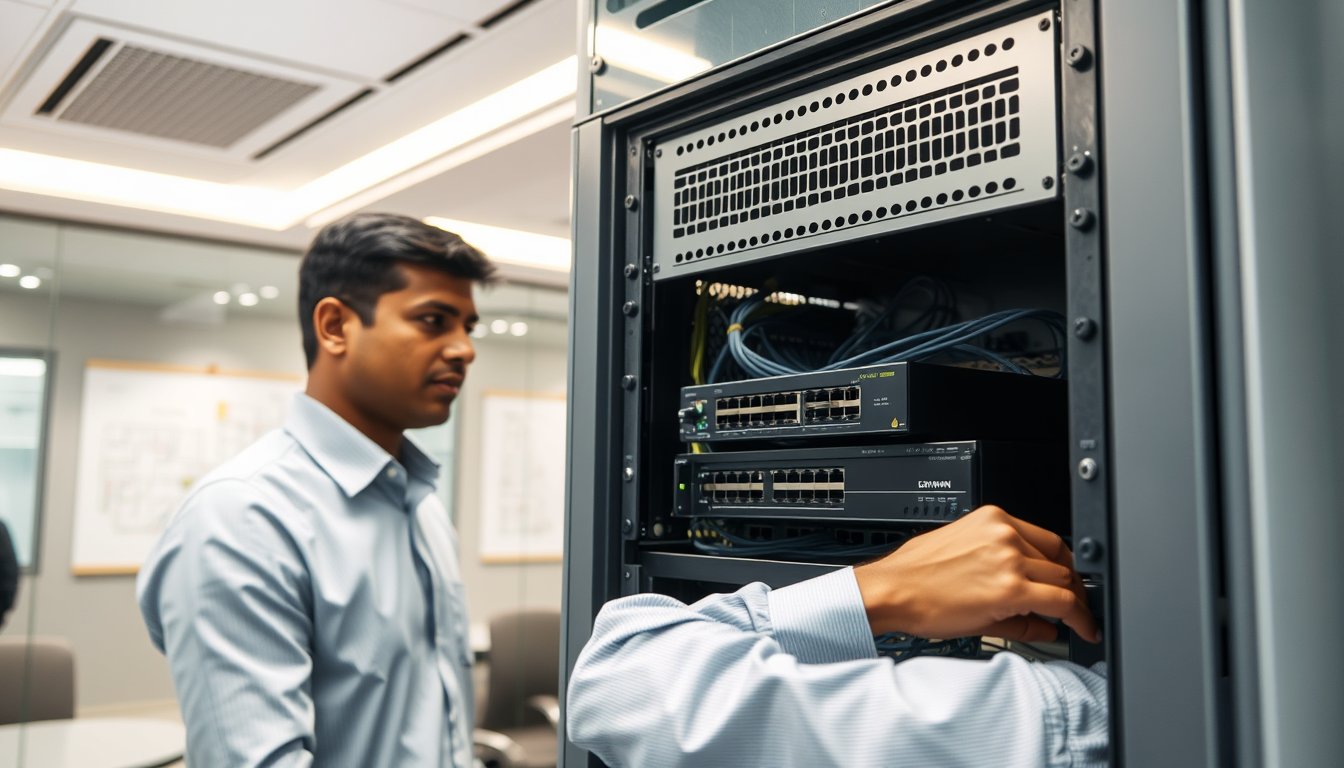
In March 2025 a mid-sized Bangalore developer opened a site office off Sarjapur Road for a 340-unit launch. The pre-launch campaign was already running. The office had a leased line installed, Wi-Fi up, two CRM terminals and a biometric attendance unit — all standard. What it did not have was a second internet path. On day four the ISP's fibre was cut during road-widening work about 600 metres away. The primary link went down at 10:40 am on a Saturday. It came back 31 hours later.
By then the sales team had missed roughly 140 inbound CRM-triggered callbacks, the channel-partner portal had gone dark, and two walk-in families who had come specifically to see the price sheet left. The developer's own estimate of the lost opportunity, prepared for the internal review, was ₹2.4 lakh in marketing spend that produced no measurable response plus one booked unit that went to a competitor project. The fix — a ₹9,800-per-month secondary broadband link from a different ISP with automatic failover — would have cost less than one week's loss.
That is the reality of IT support for real estate companies in Bangalore. The work is not glamorous. It is about making sure a temporary site office in Devanahalli behaves like the corporate office in MG Road, that the CRM does not stall when 60 people log in at 9:30 am on a launch day, and that the RERA paperwork you filed in 2019 is still readable in 2026 when the authority asks for it.
This guide covers what that actually takes, with named products, rupee figures for 2026, and the trade-offs we would tell you about even when it costs us the deal.
Why real estate IT is not the same as office IT
A software company has one office, maybe two, and a stable headcount. A real estate developer in Bangalore typically has:
- A corporate office (sales, finance, legal, HR, CRM). Usually 40–120 people.
- Three to six live site offices at any time, each with 4–15 people, each on a temporary lease, each with its own ISP connection and its own set of problems.
- A rotating cast of contractors — channel partners, architects, structural consultants, MEP consultants — who need access to drawings, approvals, and sometimes the CRM, but who are not employees.
- A document trail that has to survive a statutory retention period. RERA requires project records to be maintained for the life of the project and, for most categories, five years after completion. In practice, for a project registered in 2019 and handed over in 2024, you are keeping records until 2029 at the earliest.
- Launch events — sometimes two or three a year — that need a temporary burst of bandwidth, Wi-Fi, printing and payment terminals, then get packed up.
Each of these is a different IT problem with a different cost profile. Treating them all as "laptops and a printer" is how developers end up with a ₹4 lakh annual AMC that does not cover the actual pain points.
Site-office connectivity: the single biggest failure mode
What goes wrong
Site offices are usually in buildings that are not yet fully occupied, sometimes not fully constructed. The ISP situation is genuinely worse than a normal office:
- Lead times. A new Airtel or Jio business leased line at a site office in a peripheral area of Bangalore — Sarjapur, Devanahalli, Hennur, Jigani — typically takes 15–30 working days from application, and that assumes the building has fibre in the duct. If it does not, add 3–6 weeks for the ISP to pull cable. If the site is on a road that is being widened or re-laid (which is most of north and east Bangalore in 2026), the ISP may decline outright until the road work finishes. We have seen that push a site office to a 4G/5G router for six months.
- Power. Bangalore's peripheral areas still see 2–6 hour outages during summer and during monsoon storm events. A site office without a UPS-backed router and switch loses its internet the moment the power goes, even if the ISP link is fine. A 1 kVA online UPS (APC Smart-UPS SMT1000 or equivalent) costs ₹18,000–₹24,000 in 2026 and gives 30–45 minutes of runtime for router, switch, and one NAS.
- Cabling in monsoon. Temporary site offices on freshly levelled ground regularly see water ingress into the cable trench within the first monsoon. Cat6 run through an open trench without conduit or with a shallow PVC sleeve will fail in 6–18 months. We quote outdoor-rated Cat6 (PE-jacketed, UV-resistant) with proper conduit for any run that leaves the building envelope; the material cost difference is ₹9–₹14 per metre versus indoor cable, and it saves a re-pull.
What to do about it
The most effective connectivity pattern for a Bangalore real estate site office in 2026 is a dual-WAN router with automatic failover, plus a 4G/5G backup for the primary ISP outage case. A concrete build:
| Component | Product example | 2026 price (INR) | Notes |
|---|---|---|---|
| Dual-WAN router/firewall | FortiGate 60F or 70G | ₹48,000–₹72,000 | Handles failover, VPN to HO, basic UTM |
| Primary link | Airtel Business 100 Mbps leased line | ₹9,000–₹14,000/month | 15–30 day lead time |
| Secondary link | Jio Business 100 Mbps | ₹7,000–₹11,000/month | Different physical path is the point |
| 5G backup | FortiGate 70G with 5G modem, or a Peplink MAX BR1 Mini | ₹28,000–₹42,000 | For the case both wires are down |
| PoE switch | Ubiquiti UniFi Switch Lite 8 PoE or Netgear GS308EPP | ₹9,000–₹16,000 | Site offices use 1–2 APs |
| Access points | Ubiquiti U6 Pro (2 units typical) | ₹14,000–₹18,000 each | Better than consumer mesh for 10+ devices |
| UPS | APC Smart-UPS SMT1000 | ₹18,000–₹24,000 | Router, switch, one NAS |
| Structured cabling | Cat6 indoor, outdoor-rated for external runs | ₹1,600–₹2,400 per point | Per-point cost includes faceplate, patch panel, testing |
A 12-person site office therefore lands at roughly ₹1.6 lakh–₹2.4 lakh in one-time infrastructure plus ₹20,000–₹28,000 per month in connectivity. If you have four such sites, multiply. That is the reality of running a developer with 200+ staff across multiple active projects.
A cheaper alternative — 5G-only with a Peplink or Teltonika router — works acceptably for a 5-person site office that mostly does CRM entry and email. It fails the moment you need to sync large drawings to a NAS at HQ or run a video call with a channel partner. Know which one you are.
CRM performance: where the sales team quietly loses hours
Real estate CRMs in India — Sell.Do, LeadSquared, Housing.com's CRM, PropFlo, and Salesforce with a real estate template — all behave similarly under load: fine for 10 concurrent users, visibly slower at 40, and prone to timeout at 80+ if the deployment is SaaS and the site office connectivity is 4G.
We have seen a Bangalore developer on Sell.Do where the sales team at a Devanahalli site office was on a Jio 4G router because the leased line was delayed. CRM page loads were taking 8–14 seconds. The team had 62 leads in a single day and the agents were working in parallel in Excel because the CRM was too slow to use live. That directly corrupts lead data and creates duplicate follow-ups. The fix was not Sell.Do — it was moving the site office to a 100 Mbps Airtel link plus a FortiGate with application-aware QoS so the CRM and the VoIP softphone were prioritised over YouTube and personal streaming. Page loads dropped to under 2 seconds. Total project cost: ₹14,500 for the firewall, ₹9,200/month for the link, and two days of configuration.
A few things to get right on CRM for real estate specifically:
- Concurrency and licensing. SaaS CRMs price per user. If you have 90 users at corporate and 30 more at site offices who log in occasionally, look carefully at whether you can use concurrent or read-only seats. Sell.Do and LeadSquared both offer tiered models; ask specifically.
- The channel-partner portal. Most developers give channel partners access to a portal listing inventory. That portal must be reachable from outside the corporate network — usually it is, since it is SaaS — but it must also be behind MFA. In 2025 we audited a developer where the channel-partner portal allowed login with mobile OTP only, and 14 partner accounts were sharing a single mobile number. That is a data leak waiting to happen under DPDP.
- CRM-to-ERP integration. Many Bangalore developers run a separate ERP (SAP B1, Tally Prime with add-ons, or a custom application) for bookings, payments, and construction milestones. The integration between CRM and ERP is usually a webhook or a scheduled job, and it breaks silently. We monitor these with a simple heartbeat check and alert on miss — a 15-minute job that saves days of reconciliation.
- VoIP and call recording. Cloud telephony providers (Exotel, Knowlarity, Ozonetel) integrate with CRM and record calls for QA. Indian real estate is under RBI and RERA scrutiny for sales-call representations. Call recordings are evidence. Keep them on a system you control or with a provider that will not delete on a 90-day default.
Document workflows: the drawings, the approvals, the files that cannot be lost
A real estate company generates and consumes enormous files: architectural drawings (AutoCAD .dwg files often 20–80 MB), 3D renders (200 MB–1.5 GB per render), BOQs in Excel (10–40 MB with formulas), structural drawings in Revit (500 MB–2 GB), consultant submissions in PDF (5–60 MB), and scans of statutory approvals.
The pattern we see most often: consultants email 50 MB files to site engineers, who save them to a laptop, who then share them on WhatsApp or a free Google Drive to the contractor. Three versions exist within a week. A revision issue follows.
A cleaner pattern that fits a 50–200 person developer:
| Need | Product example | 2026 price (INR) | Notes |
|---|---|---|---|
| Central file server for active projects | Synology DS923+ (4-bay) with 4× 8 TB NAS drives | ₹1.05 L–₹1.35 L | RAID 6, one-hour snapshot every 4 hours |
| Offsite backup | Synology C2 or Backblaze B2 with Veeam Agent | ₹18,000–₹35,000/year for 2 TB | Encrypted, versioned |
| Large file transfer to consultants | Egnyte, Files.com, or a Synology with a public share on MFA | ₹9,000–₹22,000/month | Avoid free Google Drive for anything under NDA |
| Drawing review and markup | Bluebeam Revu (per user) | ₹42,000–₹58,000 per seat/year | Standard in construction; worth it |
| Document management (RERA-safe archive) | SharePoint Online (included in M365 Business Premium) or a Synology with immutability | Bundled, or ₹45,000 one-time for NAS immutability add-on | Immutability matters — see below |
The single biggest unforced error we see: developers treating the drawing folder as a working folder. It is not. It is a record. Folders that hold submitted drawings, sanctions, occupancy certificates, and RERA filings need write-once, immutable storage. Because the moment someone renames or overwrites a submitted drawing, you have lost the ability to prove what was submitted on a given date.
The failure story that changed how we design for developers
In late 2024 a Bangalore developer with a 60-person corporate office and four site offices called us after an internal audit. The audit had found that a folder containing the sanctioned plan set for two projects — 380 files including the BBMP-sanctioned plans for a 220-unit project — had a "last modified" date six days earlier, but nobody could say what had changed. The folder was on a Synology DS918+ at corporate, shared with two site offices and three external consultants, with no snapshots enabled (they had been turned off to save space).
Four days later the answer emerged: a junior architect had been given write access to the folder to "upload the new parking plan" and had renamed the entire parent folder while doing so. The rename had cascaded through three levels. When they realised what had happened, they tried to restore from the Synology's own file version history — which only retained the most recent version per file for 30 days and had been re-synced from the site office the next morning. The previous version was effectively gone.
The consequence: 11 working days to reconstruct the affected folder from emails, the consultant's own archive, and a partial backup made to an external USB drive six weeks earlier. Two approvals that had been filed with BBMP had to be re-obtained because the submitted versions could not be produced with confidence. Estimated cost in staff time and legal follow-up: ₹4.8 lakh. No data was lost permanently — but the recovery cost was real.
The fix took about two days: enable Synology's built-in snapshots (Btrfs snapshot, 6-hourly, 90-day retention), restrict write access on the sanctioned-plans folder to four named users, move the folder to a project-archive structure with folder permissions set to read-only by default and write by exception, and set up immutable offsite replication to Synology C2. The ongoing cost was ₹16,000 per year in C2 storage plus around ₹25,000 in one-time configuration. Compared to the ₹4.8 lakh recovery, the maths is not subtle.
RERA record retention: what the rules actually ask of you
RERA (Real Estate Regulation and Development Act, 2016) and the Karnataka RERA Rules 2017 impose specific document obligations:
- Every project must maintain records of all bookings, payments, and receipts.
- All approvals, sanctioned plans, and completion certificates must be preserved.
- Compliance reports and quarterly updates to the authority must be available for inspection.
- The bank-account and financial records tied to the project (70% escrow compliance) must be maintained.
The retention period the authority expects in practice is the project lifecycle plus five years post-occupancy. For a project launched 2022 and completing 2027, you are keeping records until 2032 minimum. Most of our developer clients are now managing two to four projects simultaneously, which multiplies the record volume.
A few practical difficulties that nobody tells you about when they say "keep records for RERA":
- Format. Karnataka RERA's portal (karnataka.gov.in/rera) has accepted submissions in various formats over the years, and a scan submitted in 2019 may be a 600 MB OCR'd PDF. Keep the original scan plus a lighter working copy; both will be wanted.
- Searchability. A single project's RERA folder can run 40,000+ pages. Without OCR and an index, finding a specific approval in 2031 is a multi-day job. We OCR at intake (Adobe Acrobat Pro or a Synology package) and maintain a simple master index spreadsheet per project. It saves time and pain later.
- Signatures and digital certificates. Documents signed with a DSC (Digital Signature Certificate) under Class 3 carry their own validity concerns. The signature is verifiable when the certificate is valid; after that, it relies on timestamping. For important filings, get a TSA (time-stamping authority) timestamp, not just a signed PDF. Free TSA such as FreeTSA exists; for legal weight, paid providers like eMudhra or Sify are safer. Cost is nominal (₹15–₹40 per timestamp).
- DPDP Act obligations. With the Digital Personal Data Protection Act 2023 in force (rules phased through 2025 and 2026), any personal data in your CRM and site-office systems — customer names, phone numbers, KYC documents, financial information — must be protected with reasonable security safeguards. The Act doesn't say "encryption required", but the practical standard is: encryption at rest for the CRM database, MFA on all CRM access, access logs, and a breach notification process. For a developer holding 5,000–50,000 customer records, this is real work — usually ₹60,000–₹1.8 lakh one-time to set up properly.
Temporary infrastructure for launches
Launch events in Bangalore real estate are operationally peculiar. One or two per quarter, 200–800 attendees, 9:00 am to 8:00 pm, at a hotel or a club or a site. What is needed:
- A Wi-Fi network that works for 300 phones doing 4G backups to the office Wi-Fi simultaneously.
- Payment terminals — 4–12 of them, using Pinelabs, Mswipe, or HDFC's POS — all needing a stable internet path for card authorisation.
- Digital-name-screen displays or project videos running on 3–5 TVs.
- 2–4 laptops for on-the-spot booking, CRM entry, and ID printing for token allotment.
- A large-format printer for the booking acknowledgement, usually an HP DesignJet or a Canon imagePROGRAF if you are printing drawings.
- A CCTV camera or two, mostly to reassure.
What usually goes wrong: the hotel charges ₹2.5 lakh for a 100 Mbps dedicated link and delivers 20 Mbps shared with the convention floor. Or the POS terminals work fine but fall over because the Wi-Fi is on 2.4 GHz with 40 other networks in the same band at the hotel.
The reliable pattern: bring your own connectivity. Two 5G routers (Peplink MAX BR1 Mini or Teltonika RUTX50) on two different carriers, aggregating for the POS terminals only. Bring your own PoE switch and 2–3 access points (Ubiquiti U6 Pro, again) on 5 GHz with explicit band steering. Do not use the venue's Wi-Fi for transactions. For POS specifically, use the 4G chip in the POS terminal itself where available — Pinelabs and Mswipe both offer this — with your own router as backup.
Typical one-time setup cost for a 400-person launch, excluding hotel charges and POS fees: ₹55,000–₹95,000 for the connectivity kit (which is reusable across launches) plus ₹8,000–₹14,000 in data and support per event. A repeatable, twice-a-year launch kit amortises within the first year.
What IT support for real estate typically includes — and what it should
Standard managed IT for a developer with 60–120 corporate staff and 3–5 site offices, on a Symmetrix or similar model (our approach is described briefly at /clients):
- Helpdesk — 9x5 with 1-hour response, or 24x7 for sales-critical systems during launches.
- Onsite engineer — 3 days a week at corporate, monthly at each site office, with a 4-hour response SLA for site-office outages during working hours.
- Network management — firewall rules, Wi-Fi tuning, VPN between corporate and site offices.
- Endpoint management — MDM for laptops and mobiles, patch management, endpoint security (CrowdStrike Falcon Go, or Microsoft Defender for Business at the SME tier).
- Server and NAS — patching, snapshots, backup verification. Backup verification is the part nobody does until the first time they need to restore.
- Microsoft 365 or Google Workspace — licensing, MFA, conditional access, shared mailbox and SharePoint administration.
- CRM support — tickets to the CRM vendor, integration monitoring, user provisioning.
- Vendor coordination — ISP, POS, CCTV, EPABX, and the printer rental company. This is often under-appreciated. A 60-person developer has eight or nine IT vendors and someone must own the escalation.
What distinguishes real estate from a generic office in the SLA: site-office outages must be treated as priority 1 if they affect CRM or POS during working hours, not priority 3 because "it's only four people".
What it costs, 2026
| Scenario | Setup | Annual managed IT |
|---|---|---|
| Corporate office only, 60 users, 2 sites via remote support | ₹40,000–₹65,000 | ₹4.2 L–₹6.8 L |
| Corporate 80 users + 3 site offices onsite support | ₹85,000–₹1.4 L | ₹8.5 L–₹13.5 L |
| Corporate 120 users + 5 site offices, 24x7 during launches | ₹1.2 L–₹1.9 L | ₹14 L–₹21 L |
| Add-on: DPDP / RERA record-keeping compliance setup | ₹60,000–₹1.8 L one-time | ₹18,000–₹48,000/year |
| Add-on: launch event support (per event, 6 events/year) | Reusable kit ₹55,000–₹95,000 | ₹36,000–₹78,000/year |
These are 2026 prices for Bangalore, including GST where applicable. Site office setup is costlier than corporate because everything is temporary and the ISP lead time is the same regardless.
Trade-offs we would tell you honestly
Some things we do well and some things we do not do cheaply. In the interest of you making a good decision:
- Small developers (under 30 staff, one project) do not need a full managed service. A ₹60,000–₹95,000 one-time setup and a pay-per-incident arrangement works better than a ₹3 lakh annual AMC. We will tell you if that is you.
- Large developers with in-house IT (5+ IT staff) usually do not want us to replace their team. The right engagement is a co-managed model where we own the site offices and give the in-house team escalation backup. Full outsourcing is a poor fit.
- Site-office support in far peripheral areas (beyond 40 km from our Bangalore engineers) costs more than in-city support. We have a Bangalore-based engineer; sites in Tumakuru or Kolar need travel. We charge for it; so does everyone else.
- CRM vendor support is not our line. We support the infrastructure and the integration, but we do not replace Sell.Do's or LeadSquared's own product help. Be clear with your CRM vendor on their SLA.
- We are not a system integrator for construction software. Primavera, Procore, and CMiC implementations need specialists. We can host and support the infrastructure; we will not pretend to be the application experts.
A concrete next action
If you are evaluating IT support for a developer in Bangalore, the first thing to do is not collect quotes. It is to spend one afternoon auditing four things:
- How many internet paths does each site office have, and what is the failover time? If the answer is "one" or "I don't know", you have a live and unhedged outage risk on every site.
- When did the CRM last time out, and how many leads were lost? Ask the sales head, not IT. The answers will differ.
- Can you produce the BBMP-sanctioned plan for your oldest active project in under five minutes, with the correct submission date, from a known-good version? If not, RERA-audit stress is a matter of when.
- What is the current backup — where is it, when was it last verified, and how long would a full restore of the drawing folder take? "We have a Synology" is not the same as "we tested a restore last quarter".
If any of the four answers are bad, talk to us or read more about how we work with developers and other multi-site clients at /clients. The audit is free, takes half a day, and will tell you more about your real IT risk than any pitch deck.
FAQ
How much does IT support cost for a real estate company in Bangalore?
For a developer with 60–120 corporate staff and 3–5 site offices, expect ₹8.5 lakh to ₹14 lakh per year for managed IT in 2026, plus ₹55,000–₹95,000 in launch-event connectivity kit and ₹60,000–₹1.8 lakh one-time if you are doing DPDP and RERA record-keeping compliance work. Smaller developers (under 40 staff, one project) can get adequate support for ₹3.5–₹6 lakh per year.
How long does it take to get internet at a new site office in Bangalore?
A new Airtel or Jio leased line typically takes 15–30 working days from application, assuming the building has fibre in the duct. If the building does not — common at new sites on Sarjapur, Devanahalli, Hennur, and Jigani roads — add 3–6 weeks, and up to several months if the road is being widened. Plan the site office connectivity 6 weeks before the office opens, not 2.
Do we need to keep records for RERA, and for how long?
Yes. Karnataka RERA expects project records — bookings, payments, approvals, sanctioned plans, completion certificates, and compliance reports — to be maintained for the life of the project and at least five years after completion. For a project launched in 2023 and completing in 2028, that is 2033 minimum. In practice, developers keep such records for 10+ years because disputes and redevelopment can come up later.
Is cloud backup enough for RERA compliance?
Cloud backup is necessary but not sufficient. The compliance requirement is that you can produce a specific historical record on demand. That means versioning, immutability (write-once), and a retention policy that prevents deletion. A standard cloud backup with 30- or 90-day retention will not satisfy a 7-year retention requirement. Use long-term retention storage (Synology C2, AWS S3 Glacier, Azure Archive) with object-lock enabled.
What is the biggest IT failure risk for a Bangalore real estate firm?
Single-path internet at a site office, followed by CRM timeouts during a launch, followed by loss of an unversioned drawing or approval. Power and cabling failures are next. All four are solvable with cheap infrastructure — the problem is doing it before the failure, not after.
Can IT support be engaged only for site offices?
Yes. Several developers keep their corporate IT in-house and outsource site-office support to us because the geographic spread makes it hard to do with a small head office team. Pricing is per site office, typically ₹45,000–₹70,000 per site office per quarter in 2026 depending on distance and whether an onsite visit is monthly or fortnightly.