
Projector Rental in Bangalore for Events: Lumens, Screens, Day Rates
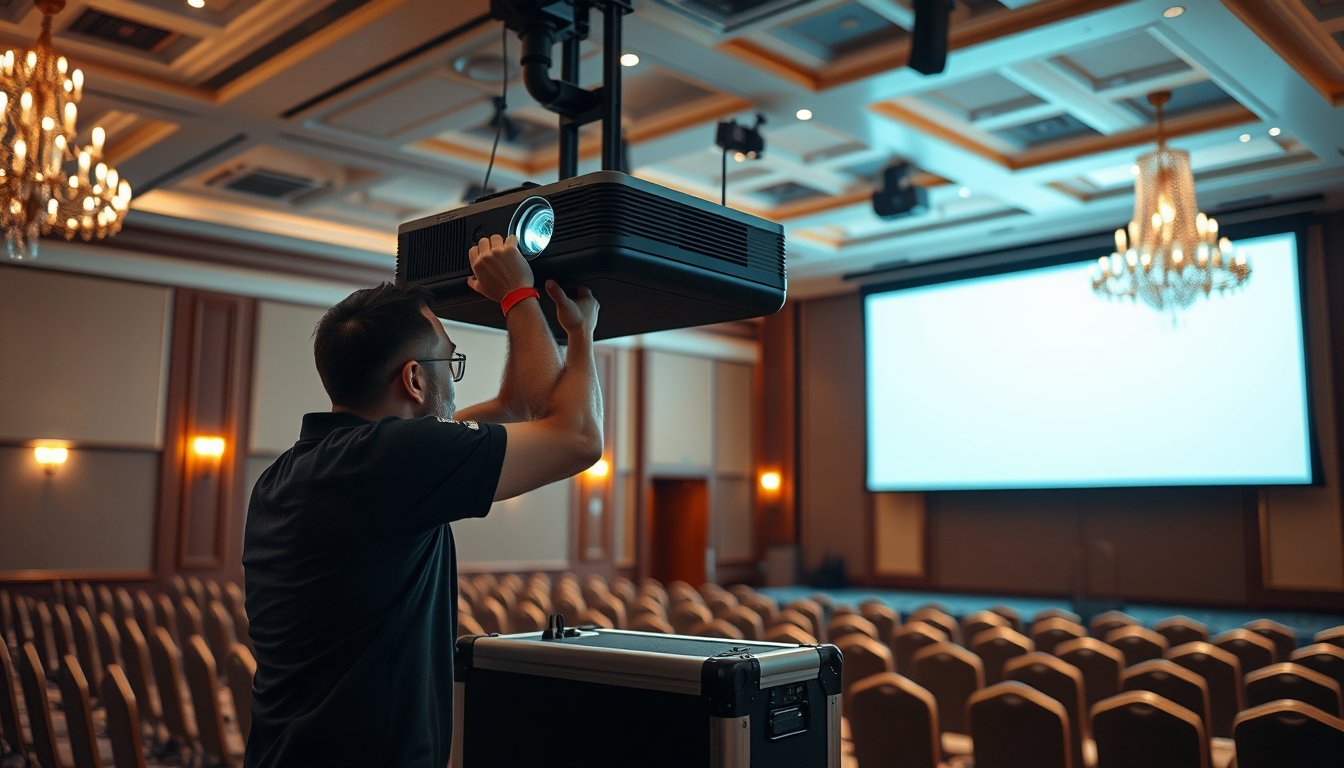
The 3,000-lumen projector that ruined a ₹4.2 lakh product launch
In March 2025 we took a call from an events coordinator at a hotel on Old Airport Road. She had booked a 2,800-lumen portable projector for a product launch in a banquet hall with 14 downlight circuits and full-height glazing on one wall. The AV vendor had quoted on room dimensions, not on light.
By 4pm the hall was full, the lights were up because the catering staff needed them up, and the projected logo on the 12-foot screen was a pale grey smudge. She called us at 4:40pm. We got an 8,000-lumen laser unit and a high-gain screen to the venue by 6:10pm. The re-stage cost the client ₹38,000 in extra rental and crew overtime. The alternative — running the launch with a visibly washed-out main screen — would have cost far more, and there were 90 seconds of awkward silence while the swap happened.
That call is the whole reason this article exists. Projector rental in Bangalore is not a line item you negotiate on price alone. Lumens, ambient light and throw distance decide whether your event reads as professional or amateur, and those three numbers interact with the venue in ways a spec sheet will not tell you.
We supply and support AV and IT equipment for corporate events, town halls, training rooms and conferences across Bangalore, and we also cover the boring parts — power, cabling, network for streaming, and a technician who actually shows up. If you want to see how that fits into our wider support offering, look at our rental support services page.
Lumens by venue size and ambient light: the table you actually need
Let us stop being coy. The single most common mistake is choosing a projector by room capacity. A 200-seat hall with blackout curtains needs less than half the lumens of a 120-seat boardroom with floor-to-ceiling glass facing west.
Here is the working rule we apply on site. It is not a manufacturer's marketing number; it is what we have found holds up when the lights are on and people are sitting in the room.
The ambient-light matrix (2026 working figures)
| Venue / lighting condition | Typical room size | Seating | Recommended projector lumens | Realistic models we deploy |
|---|---|---|---|---|
| Boardroom, blackout curtains | 400–600 sq ft | 8–14 | 2,500–3,500 | Epson EB-FH52, BenQ MH733 |
| Boardroom, blinds only, daylight | 400–700 sq ft | 8–16 | 4,000–5,000 | Epson EB-2250U, BenQ LK935 |
| Training room, mixed lighting | 700–1,200 sq ft | 20–40 | 5,000–6,500 | Epson EB-PU1007B, Panasonic PT-VMZ61 |
| Hotel banquet, controlled lighting | 1,500–2,500 sq ft | 80–150 | 7,000–9,000 | Panasonic PT-RZ790, Epson EB-PU2010B |
| Hotel banquet, chandeliers on, glazed wall | 1,500–3,000 sq ft | 100–200 | 10,000–14,000 | Panasonic PT-RZ21K, Epson EB-PU2216B |
| Conference hall / auditorium | 3,000–6,000 sq ft | 200–400 | 12,000–20,000 | Panasonic PT-RQ22K, Barco UDX-4K32 |
| Large plenary or stage, high ambient | 6,000+ sq ft | 400+ | 20,000–30,000 or LED wall | Barco UDX-4K32, or 2.6mm LED |
Two points on that table.
First, the jump from 5,000 to 10,000 lumens is not linear in price. It is roughly a 3x jump in rental cost because you move from lamp/laser portable units to large-venue laser projectors that arrive in a flight case with two technicians.
Second, at the 20,000-lumen end, you should be seriously considering an LED wall instead. For a stage backdrop at an AGM or a large product reveal, a 2.6mm or 2.9mm LED wall at typical Bangalore pricing now competes with a 20,000-lumen projector plus a 20-foot fast-fold screen plus two operators. It is heavier on logistics but it does not care about house lights at all. We quote both and let the client decide, and honestly, for anything over 15,000 lumens in an uncontrolled-light venue, we usually recommend the LED wall.
The informal doubling rule
If you cannot measure the room, use this. Take the projector's rated lumens and halve them if the room has: (a) daylight through glazing, (b) house lights above 50%, or (c) a large white wall behind the screen bouncing light back. Whatever number remains needs to clear roughly 60 lumens per seat for PowerPoint and 90 lumens per seat for video. That is a crude test, but it has saved more events than any single spec sheet.
A quick worked example. A 120-seat hotel banquet on Residency Road, glazed on one side, chandeliers dimmed but not off. Rated 9,000 lumens. Halve it for the glazing: effective 4,500. Split across 120 seats: 37 lumens per seat. That is fine for a keynote, marginal for a video-heavy demo. The right answer for that room is 12,000–14,000 lumens, or an LED wall.
Throw distance: the number that gets discovered at 4pm on event day
Throw distance is the gap between the projector lens and the screen. It is fixed by the venue. You cannot negotiate with a hotel ballroom's ceiling height or the position of the retractable mount.
Every projector has a throw ratio: distance divided by image width. A projector with a 1.5–2.0:1 ratio needs 1.5 metres of distance for every metre of screen width, at minimum. So a 4-metre-wide (roughly 13-foot) screen needs a minimum of 6 metres of throw.
Why this bites people in Bangalore hotels
Many hotel banquet halls have ceiling-mounted projector plates placed 4 to 5 metres from the front wall. If you want a 4-metre-wide screen in that room, you need a throw ratio of 1.0–1.25:1 — a short-throw or ultra-short-throw unit, not the standard portable projector the AV vendor quoted. Short-throw units cost more to rent. Ultra-short-throw units (0.25:1 or so, sitting on a credenza right under the screen) cost more again, and they are physically heavier.
| Screen width | Minimum throw at 1.5:1 | Minimum throw at 1.2:1 | Minimum throw at 0.8:1 | Typical venue fit |
|---|---|---|---|---|
| 2.0 m | 3.0 m | 2.4 m | 1.6 m | Small boardroom |
| 3.0 m | 4.5 m | 3.6 m | 2.4 m | Training room |
| 4.0 m | 6.0 m | 4.8 m | 3.2 m | Mid-size banquet |
| 5.0 m | 7.5 m | 6.0 m | 4.0 m | Large banquet / auditorium |
| 6.0 m | 9.0 m | 7.2 m | 4.8 m | Stage front projection |
Our standard practice when quoting a hotel venue is to ask for the distance from the mounting plate to the front wall, in metres, and the room's clear ceiling height. If the client does not have those, we send someone to measure. It takes 40 minutes and it prevents a very expensive improvisation on event morning.
Lens shift and keystone
Two things to know. Vertical lens shift lets you move the image up or down without physically moving the projector — 50% vertical shift is common on large-venue units and it matters hugely when the projector is on a ceiling plate and the screen is lower than ideal. Keystone correction, on the other hand, distorts the image to force it into a trapezoid. Digital keystone is a rescue mechanism, not a plan. If you need more than about 8 degrees of keystone, you have the wrong projector or the wrong mount. Insist on lens shift.
Screen pairing: gain, format and why a cheap screen wastes a good projector
A screen has a gain number. Gain 1.0 is a matte white reference. Gain 1.3–1.5 reflects more light back toward the audience — useful in a bright room, but it narrows the viewing angle, so people seated at the far sides see a dimmer or slightly colour-shifted image. Gain 0.8 (grey screens) reduces ambient light washout in rooms with poor light control.
Pairs that work in practice:
- 8,000-lumen laser unit, bright banquet hall with glazing → 1.3–1.5 gain fast-fold screen, 16:9, matte white. The gain compensates for the ambient light; the viewing angle is acceptable for a wide room.
- 5,000-lumen unit, training room with controlled lighting → 1.0 gain screen, 16:10 if the content is mostly documents. Higher gain would over-brighten the centre and show hot spots.
- 12,000-lumen unit, large hall → 1.0–1.2 gain, and check the screen's rated maximum brightness. A cheap 1.0-gain screen with a 12,000-lumen projector in a dim room will look blown out.
Aspect ratio matters too. Most laptops are 16:9 or 16:10. Most event content is 16:9. If a client delivers a 4:3 deck, it will letterbox — grey bars on the sides — and nothing the projector does will fix it. Ask your presenter for the aspect ratio when you book equipment. This is a 30-second email that prevents a 30-minute argument.
We have lost count of the number of times a client has rented a 12,000-lumen projector and then paired it with a borrowed 8-foot tripod screen from the office store room. That is like fitting a lorry engine to a hatchback. The screen is not an accessory; it is half the optical system.
Day-rate pricing in Bangalore, 2026
Rental pricing in Bangalore is a function of three things: unit class, delivery distance, and whether you need an operator. Delivery from a vendor in Peenya to a hotel in Whitefield is 32 km each way, on a weekday, and takes 90 minutes. That shows up in the quote.
Here is the day-rate banding we work with for 2026, for a full working day (typically up to 8 hours, delivery, setup and pickup included for city-centre venues):
| Equipment class | Lumens | Day rate (₹) | Delivery + setup | Operator |
|---|---|---|---|---|
| Portable, boardroom | 2,500–3,500 | 4,500–7,000 | 800–1,500 | Optional, 2,000–3,500/day |
| Portable, bright room | 4,000–5,000 | 7,000–11,000 | 800–1,500 | Optional, 2,000–3,500/day |
| Short-throw | 4,000–6,500 | 11,000–16,000 | 1,500–2,500 | Often required, 3,000–4,500/day |
| Large-venue laser | 7,000–9,000 | 18,000–28,000 | 2,500–4,000 | Required, 4,000–6,000/day |
| Large-venue laser | 10,000–14,000 | 28,000–45,000 | 3,500–5,500 | Required, 5,000–7,500/day |
| Large-venue laser | 20,000–30,000 | 65,000–1,10,000 | 6,000–12,000 | Two operators, 12,000–16,000/day |
| LED wall (2.6–2.9mm) | n/a | 25,000–40,000 per 10 sq m | 8,000–18,000 | Required, 4,000–6,000/day |
A few notes that the table cannot carry.
Weekly rates are not seven times the day rate. They are usually 4.5 to 5.5 times the day rate. A 9,000-lumen laser at ₹22,000/day is typically ₹1,00,000–₹1,20,000 for a week (2026 pricing). If your event runs three days, always ask for the weekly number and then negotiate the day rate against it.
GST is 18% on equipment rental. If your company is GST-registered, the input credit is recoverable, so the effective cost to you is the pre-tax number, provided the rental vendor issues a proper tax invoice with a GSTIN. Make sure the quote is either clearly inclusive or clearly exclusive. We have seen clients compare a ₹18,000 inclusive quote against a ₹19,000 exclusive one and get it badly wrong — the second is actually cheaper to a GST-registered business by about ₹1,700.
Delivery is the hidden line item. A venue in Electronic City, a venue in Hebbal and a venue in Whitefield are three completely different transport problems. Ask whether the quote includes two-way delivery and crew, and whether overtime past 8pm is charged.
Monsoon surcharges and delays. Between June and October, a projector in a flight case on an open-load tempo is a problem. We insist on closed-body vehicles for all laser units above 7,000 lumens, and we build 30–45 minutes of buffer into outdoor and semi-outdoor event setups. Water in a fast-fold screen frame is survivable; water in a laser projector's intake is not. We have written off one unit in eight years due to rain ingress, and it was a ₹3.8 lakh repair we simply absorbed. Ask any vendor what happens if the unit is damaged on site — who carries that risk, you or them.
On-site technician cover: when you need it and when you are paying for comfort
There is a lot of nervous upsell in this category. Let us be straight about which deployments actually need an operator and which do not.
| Scenario | Technician needed? | Why |
|---|---|---|
| Boardroom, 10 people, single laptop, 3-hour meeting | No | Portable unit, HDMI, done |
| 60-seat town hall, one laptop, live Q&A | Recommended (basic operator) | Source switching, mic levels, screen focus |
| 150-seat conference, two presenters, video playback | Yes | Presenter changes, aspect ratio mismatches, video codecs |
| Multi-session event, 3+ rooms, 2 days | Yes, minimum one per two rooms | Failure in room B while you are in room A |
| Hybrid event with live streaming | Yes, plus a network/AV tech | Projector + camera + encoder + stream health |
| Stage plenary with LED wall and switcher | Yes, two operators | Switcher, content, screen and stage cues |
An operator for a single-room corporate event usually costs ₹3,000–₹4,500 per day (2026 pricing), and that covers setup, focus, source management through the event, and teardown. That is 15–20% of the projector rental. It is the cheapest insurance in the whole budget.
What the operator is actually doing during your event:
- Re-focusing after the room warms up. Laser projectors hold focus better than lamp units, but a fast-fold screen can settle, and a mount can shift if someone bumps the table.
- Switching sources without a 12-second black screen. A presenter fumbling for the right HDMI input in front of 200 people is a memory nobody wants.
- Handling a laptop that outputs 4:3 or 16:10 unexpectedly and letterboxing it cleanly.
- Catching colour-temperature drift when the house lights come up mid-session, and compensating with a saved picture mode.
- Being physically present to stop someone from unplugging the wrong cable.
The last one sounds trivial. It is not. Cables get unplugged at events the way coffee gets spilled at events.
If your event involves live streaming or a hybrid audience, the projector is only part of the AV chain. This is where our event and rental support scope usually expands to cover the network side — dedicated VLAN, upload bandwidth, and a fallback bonded 4G/5G link, because hotel Wi-Fi at 4pm on event day is not something to build a live stream on.
The failure story: a three-day conference, a dead lamp, and ₹1.9 lakh of re-stage
In November 2024 we supported a three-day conference at a convention centre on Tumkur Road. Around 320 delegates, three breakout rooms plus one main hall, hybrid streaming from the main hall.
The event company had sourced projectors independently through a broker. The main hall unit was a lamp-based 7,000-lumen projector, roughly four years old, with a lamp that had an unknown number of hours on it. Nobody checked the lamp hours. The unit ran for about six hours on day one — keynote, two sessions, and a panel — and on the morning of day two, the lamp failed during the opening address. Not dimmed. Failed. The projection went black for about 90 seconds, and the stream carried the dead screen to roughly 400 remote attendees.
The original vendor's replacement unit was a 5,000-lumen portable, which was in the same room with the same ambient light and looked visibly worse than the dead projector had on day one. The client escalated to us mid-morning. We delivered a 10,000-lumen laser unit and a matched 1.3-gain screen, ran a 25-minute swap during the coffee break, and stayed on site with an operator for the rest of the event.
The cost breakdown, as it landed on the client:
- Emergency replacement rental and crew, two days: ₹96,000
- Lost sponsorship exposure and re-shot content for day two morning: ₹70,000
- Streaming overage and re-encoding: ₹14,000
- Client's internal AV coordinator time, two days: roughly ₹10,000
Total: about ₹1.9 lakh of avoidable cost on a projector that had been rented for around ₹54,000 for three days. The fix, had it been planned: a laser source (no lamp to fail), a documented lamp/light-source hours check at setup, and a pre-agreed replacement SLA. The whole thing would have cost an extra ₹18,000 at booking.
That is the arithmetic of projector rental. The failure mode is rarely the projector breaking in an obvious way. It is a consumable — a lamp — reaching end of life at the worst possible moment, or a throw ratio that nobody checked, or a screen that was the wrong gain for the room. All three are predictable and all three are cheap to prevent at the quotation stage.
A laser light source rated at 20,000 hours is not going to fail during your two-day event. A lamp unit with 3,400 hours on a 4,000-hour lamp might. If a vendor cannot tell you the light-source hours on the unit they are sending, that is your answer.
Power, cabling and the Bangalore operational realities
Projectors are low-draw compared to most event equipment, but they are sensitive to power quality, and Bangalore's commercial power has the usual quirks.
UPS on every large-venue unit. A 10,000-lumen laser projector draws around 700–900W. A 1kVA online UPS will carry it through a 3–6 second changeover and give you clean shutdown on a longer outage. We put a UPS on every unit above 5,000 lumens as standard. Below that, a decent surge protector and a stable circuit is usually enough, but if the venue's power is on a shared circuit with catering equipment, insist on the UPS.
Dedicated circuit. Never share a circuit with a commercial coffee machine, a chafing dish warmer, or an LED lighting array. The inrush current from catering equipment causes voltage dips that can reset a projector mid-presentation. We have seen a projector reboot at the exact moment a 200-cup coffee urn clicked on.
Cable management and monsoon. Indoor venues are fine. Outdoor and semi-outdoor setups — a lawn event at a resort off Kanakapura Road, a terrace product launch — need cable ramps, IP-rated connections, and a plan for a sudden shower. Outdoor laser projector housings are weather-resistant, not waterproof, and a 20-minute downpour will find the seams. If the weather forecast is uncertain, the LED wall in a marquee is the lower-risk option.
Cabling length. HDMI degrades over distance. For runs beyond 10 metres, use HDMI over HDBaseT or an optical HDMI cable. A 15-metre passive HDMI cable from a laptop to a stage projector will drop the signal intermittently, and the symptom looks like a faulty laptop, not a faulty cable. This is a very common source of "my laptop does not work with your projector" at events. It is almost always the cable.
How to scope and book this properly
Here is the checklist we use when a client asks us to quote projector rental in Bangalore for an event. Run through it before you send an enquiry to any vendor, and you will get comparable quotes instead of apples-to-oranges ones.
- Room, not seats. Give the venue's dimensions, ceiling height, glazing orientation and lighting control. A photo of the room from the back is worth more than a floor plan.
- Mount point to screen-wall distance, in metres. If the venue cannot tell you, ask for a site visit. Any serious vendor will do one.
- Screen width you need, and aspect ratio of your content. 16:9 for most decks. Confirm with your presenters.
- Ambient light during the sessions. Will house lights be up? Are the blinds operable? Is there a skylight?
- Source devices and connectors. How many laptops, what ports (HDMI, USB-C, DisplayPort), and will anyone present from a phone or tablet?
- Whether you need operator cover and for how many hours. Including rehearsals and teardown.
- Delivery address, dock access and lift availability. A flight case for a 20,000-lumen projector does not go up a narrow staircase cheerfully.
- Power availability at the projector position. A dedicated 16A circuit is standard; confirm it is not shared.
- What happens if the unit fails. Get the replacement SLA in writing, with a time commitment.
- Whether the quote is GST-inclusive and whether delivery, setup, teardown and overtime are in it.
If you want to talk through a specific event, our team can quote against your venue and date. The contact page goes straight to the desk that handles event rental scheduling.
Where this approach is not the right fit
We are not the cheapest quote you will get. If you are renting a single 3,000-lumen projector for a two-hour internal meeting in your own office, and you have a laptop and a screen already, a marketplace or a local AV shop will do it for less and faster. Use them.
We are also not the right fit if you want to self-operate a 20,000-lumen stage rig. The insurance and the failure risk do not work. For anything above 10,000 lumens, or any event with live streaming or an LED wall, we insist on operator cover as part of the quote — we will not rent the unit on a self-operate basis, and that has cost us a couple of deals. Fine.
And if your event is a one-off with no recurring AV need, our value is mostly in the scoping and the failure cover. If you run events every quarter, the more interesting conversation is a retained AV support arrangement with your regular venues, pre-scouted and pre-measured. That is where the cost actually comes down over a year, because the second event at the same venue is nearly free of surprises.
FAQ
How many lumens do I need for a 200-seat conference hall in Bangalore?
For a controlled-light hall, 8,000–10,000 lumens. If the house lights will be up or there is significant daylight through glazing, go to 12,000–14,000 lumens, or consider an LED wall. Do not size by seats alone; size by ambient light.
What does projector rental cost per day in Bangalore in 2026?
A 3,000-lumen portable runs ₹4,500–₹7,000 per day. A 9,000-lumen large-venue laser is ₹18,000–₹28,000. A 20,000-lumen stage unit is ₹65,000–₹1,10,000 per day plus two operators. Add 18% GST and confirm delivery and setup are included.
Do I need a technician on site for a corporate event projector?
For a single-laptop boardroom session, no. For any event with multiple presenters, video playback, hybrid streaming, or more than 100 attendees, yes. Operator cover is typically ₹3,000–₹7,500 per day and prevents the most common event-day failures.
Can you deliver and set up at a hotel banquet hall in Bangalore?
Yes, and we scope the venue first. We need the mounting-plate-to-screen distance, ceiling height and lighting conditions. Site visits take about 40 minutes and are the single best way to avoid a throw-distance problem on event morning.
What is the minimum notice for a projector rental booking?
For units up to 5,000 lumens, 24–48 hours is usually fine. For large-venue laser units above 10,000 lumens, book 7–10 days ahead; during peak conference season (October to February) book two to three weeks ahead, because the same units are shared across venues.
Is it better to rent a high-lumen projector or an LED wall?
Above roughly 15,000 lumens in a room with uncontrolled ambient light, an LED wall usually wins on visibility and reliability. Below 10,000 lumens in a controlled room, a projector is cheaper to move, faster to set up and easier on the venue. We quote both when the room is borderline.
What to do next
Pick your venue, then send us three numbers: room length in metres, ceiling height, and how many people you are seating. Add a photo of the room from the back, taken with the house lights on. That is enough for us to quote the right lumens, throw ratio and screen in one pass, with a replacement SLA attached and an operator costed in if the event needs one. If your event is within the next two weeks, say so in the first line — peak-season stock on large-venue lasers moves fast.