
Video Conferencing Setup for Boardrooms in Bangalore
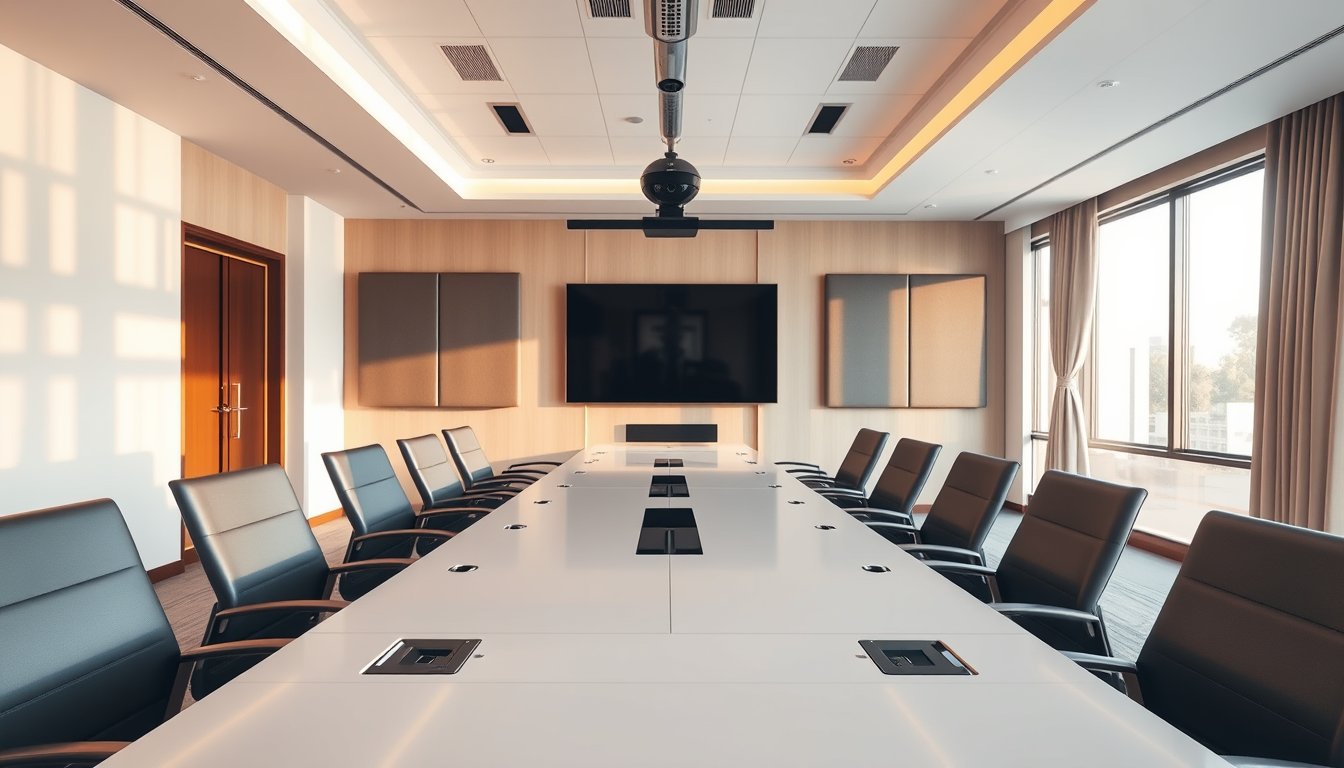
The ₹9.4 Lakh meeting that nobody could hear
A 60-person logistics firm off Old Airport Road called us in March 2025. They had spent ₹9.4 lakh the previous year on a boardroom refresh — a 75-inch display, a Logitech Rally Bar, a Shure MXA910 ceiling array, and a Crestron control panel. Beautiful room. Marble table. Twelve seats, four of them at the far end against a glass wall facing the corridor.
Their Singapore parent company held a quarterly review. Nine minutes in, the group CFO said, over the call: "We cannot hear Chennai."
Actually, the CFO meant the Bangalore team. The MXA910 had been mounted on a 9-foot ceiling and its beamforming was set to a factory default that assumed roughly 3 metres of throw. The pickups were working. The issue was the marble table — a hard, flat reflective surface 8cm thick with zero absorption — bouncing the Indian English consonants back into the array's lobes. The far-end heard the room, not the speaker. Add a 700ms one-way latency from a badly configured ISP path and the whole thing fell apart for forty-five minutes.
The fix took four hours and cost ₹38,000. Two absorptive panels. Recalibration of the array. A ceiling-mounted LED light bar so the camera at the far end could expose faces instead of silhouetting them against the corridor glass. That was it. No new hardware.
The lesson: a video conferencing setup for a boardroom in Bangalore fails or succeeds on acoustics, camera framing, and pickup geometry — not on whether you bought the most expensive bar in the catalogue. This article is about the numbers behind all three, room by room.
If you want someone to do the survey and the install properly, our communications practice covers this end to end. For everything else in a Bangalore office, there's a lot of content here already, but this piece stays on the boardroom.
What "boardroom" actually means in sizing terms
Indian companies throw the word "boardroom" at rooms ranging from a 6-seat huddle to a 24-seat executive chamber. The kit is not the same. Sizing has to start from seats and the table footprint, not from a wish-list.
The three boardroom tiers we see in Bangalore
| Tier | Seats | Typical table size | Room area | Real-world example |
|---|---|---|---|---|
| Small boardroom | 6-9 | 2.4m × 1.2m oval | 15-22 sqm | MG Road professional services offices |
| Mid boardroom | 10-14 | 3.6m × 1.4m boat-shape | 26-40 sqm | Mid-stage manufacturing HQs, Whitefield |
| Executive boardroom | 14-22 | 5.0m × 1.8m boat-shape, often with a return | 45-90 sqm | Listed-company board rooms, CBD |
Two-thirds of Bangalore boardroom enquiries we receive are for the mid tier: 10 to 14 seats. That is the room where kit choices matter most, because you are too big for a single all-in-one bar to work perfectly, and too small to justify a full Cisco Room Bar Pro + dual-camera setup.
What the room dictates before you buy anything
The choice of camera, mic, and display follows from five measurable things. Take these numbers into any sales conversation:
- Longest camera-to-farthest-face distance — in metres. If it exceeds 6m you need optical zoom, not digital.
- Ambient noise floor — in dB(A). Measured with a ₹4,000 sound level meter, at the seats, not at the door. In a CBD building with a DG set below the floor, a typical boardroom floor in Bangalore reads 42-48 dB(A) at 9am and 48-54 dB(A) at 6pm when the chiller kicks in.
- Reverberation time (RT60) — how long a hand clap takes to die out. Over 0.6 seconds in a glass-and-marble room is a problem.
- Ceiling height — ceiling arrays need 2.7m minimum, 3.0m is comfortable, 4.5m+ needs a different product class.
- Glazing — how much glass. This dictates display size, camera placement, and whether you have to add blinds.
Most integrators skip item 2 and 3. Those are the two numbers that decide whether your ₹14L setup sounds good or sounds like a bathroom.
Camera framing by room size — the only rule that matters
The reason most boardroom cameras feel wrong is not the sensor. It is the horizontal field of view combined with where the camera is placed. A wide-angle lens at 3 metres of a 3.6m table is a security-camera shot. A narrow lens at 7 metres of the same table is a head-and-shoulders shot of two people.
The rule of thumb we use
Aim for the far-end to see faces at roughly the same scale as in a normal person-to-person meeting at 1.2m distance. In practice:
- Small boardroom (6-9 seats): a single 4K bar with 110-120° horizontal FoV, mounted below or above the display at 2.2-2.6m from the table's far edge.
- Mid boardroom (10-14 seats): a PTZ camera with 12-20× optical zoom, mounted above the display at the far-end wall, so the far-host can bring the speaker to a natural framing.
- Executive boardroom (14-22 seats): two cameras — one wide at the display wall for "whole room", one PTZ at the far end for "speaker close-up". Automatic speaker-tracking from one wide camera is a compromise.
Named kit that actually maps to those rules
| Room tier | Camera options we install and trust | Rough street price (2026, INR) |
|---|---|---|
| Small boardroom | Logitech Rally Bar (native 4K, 4.1× lossless zoom), Poly Studio X52, Yealink MeetingBar A40 | ₹2.10L – ₹3.40L (bar only) |
| Mid boardroom | Logitech Rally Camera (15×), Aver VB342 Pro, Huddly IQ paired with a mini-PC | ₹1.60L – ₹3.10L (camera only) |
| Executive boardroom | Cisco Room Bar Pro + Quad Camera, Sony SRG-A40 PTZ, Aver PTZ310 | ₹4.20L – ₹9.80L (cameras, before codec) |
Do not buy a 4K camera and mount it at eye-level on a low cabinet facing the length of the table. You will get chins. The camera should be at 5-10cm above standing eye level when seated — about 1.30m to 1.40m from finished floor — or on the same wall as the display, at 1.6m to 1.8m.
The camera-height mistake we see over and over in Bangalore boardrooms
Bangalore's new-build offices in Whitefield and along Outer Ring Road frequently have flush-mount ceiling features. Integrators love hanging cameras from them because it avoids visible cabling. Ceiling cameras at 3m looking down at 45° are fine for a 20-seat room where down-the-table geometry works. They are wrong for a 10-seat room because the near two seats appear as the tops of heads, and the CEO at the head appears foreshortened. Every ear-to-mouth distance crosses at the wrong angle. Meeting fatigue sets in after twenty minutes and you will not know why.
The workaround: if ceiling mounting is forced by the room, use a camera with manual tilt and a 3-5° downward offset, at no more than 2.8m height, and add a 55-inch confidence monitor on the far wall so speakers look at something other than the ceiling. This adds roughly ₹62,000 to the build.
Microphone pickup — where 80% of "bad VC" complaints come from
If I had to rank the causes of "the video call was bad" complaints in the 200+ boardrooms we have touched across Bangalore, microphones are responsible for about eight in ten. Specifically, three failure modes:
- Far-field pickup at the wrong beam width — the mic hears the AC, or a corridor conversation, or two adjacent people at once.
- Feedback from the speakers — echo on the far side, usually caused by speakers too loud in a hard-surfaced room with no acoustic treatment.
- Reference mismatch — echo cancellation on the bar is fine, but the ceiling array's AEC has been set for a 3m ceiling while the room has 3.6m.
Mic options by room tier
| Mic type | Best for | Pickup pattern | Street price (2026, INR) |
|---|---|---|---|
| Bar-integrated mic array (e.g. Rally Bar's 6-mic array) | Small boardroom, up to 4m table | 4.5m range, up to 7 participants | Included in bar (₹2.10L-₹3.40L) |
| Table-top omnidirectional (Poly Trio C60, Yealink CP965) | Small to mid, on-table | 4-6m radius | ₹78,000 – ₹1.35L |
| Ceiling array (Shure MXA910, Sennheiser TeamConnect Ceiling 2, Biamp Parlé TCM-XA) | Mid to executive, when the table should stay clean | 6-9m covered area, configurable lobes | ₹2.40L – ₹5.10L per array + DSP |
| Wired table microphone chain (Shure MXA310 table array, Audio-Technica ES945) | Long boat tables, fixed positions | 2-3 per table for 10-14 seats | ₹48,000 – ₹92,000 each |
Why ceiling arrays fail more than they should
A ceiling array like a Shure MXA910 sends a beam down at a seat and processes what comes back. Two things break it.
Reflective surfaces. Glass table, marble table, polished granite — that's a Bangalore boardroom standard and each one reflects the same voice back up. The array's beamformer picks up the reflection as a second arrival and the AEC hesitates.
HVAC and ceiling noise. Bangalore offices with split or VRF units running at 350-450 CFM at the diffuser put 46-52 dB(A) into the room. The MXA910's beamformers can still hear the speaker at 3-4m, but the far end gets a rushing-air background. Some far-end participants will just say "you sound bad" and stop trying.
Concrete fix from our Old Airport Road story earlier: 50mm acoustic panels on two opposing walls, at 1.2m-2.4m height, in a staggered pattern. That alone dropped RT60 from 0.82s to 0.51s. Panel cost, installed: ₹22,000-₹34,000 per wall for a 3.6m x 2.4m treatment.
The reference-book observation on ceiling mics
Ceiling arrays are excellent, but 60% of the ones we service have never had their beamformers tuned to the actual room. If you currently run an MXA910 and nobody has calibrated it in two years, spend ₹15,000-₹25,000 on a professional re-tune before you spend ₹4 lakh on new hardware. It is the single best rupee-to-outcome ratio in this entire article.
Display sizing — get this wrong and you'll replace the panel next year
The single most common mistake in Bangalore boardroom refreshes is a display that is one size too small. The 65-inch panel that "felt big" in a showroom feels cramped across a 4m table.
The formulas we actually use
- For content visibility (spreadsheets, dashboards, decks): minimum screen height should be at least 1/6th of the distance from the farthest viewer's eye to the screen.
- For people visibility (the far end's faces): same rule but at 1/5th minimum, because facial expressions need more resolution than text.
Practical outputs:
| Room tier | Farthest viewing distance | Content minimum | Comfortable |
|---|---|---|---|
| Small (6-9) | 3.5m | 55" | 65" |
| Mid (10-14) | 5.5m | 75" | 86" |
| Executive (14-22) | 8.0m | 98" | 110" + a confidence display at the far end |
At a 7m viewing distance, a 75-inch panel gives each participant a head-height image of about 4.8cm on screen. That is roughly the size of a thumbnail. It is impossible to read facial expression from that. A 98-inch panel gives you 6.3cm. Still small. This is why the executive boardroom needs its own display for the far end — often a second 55" or a 65" panel at the far wall, mirroring the same feed but at the scale the far half of the table can actually see.
Panel choices that make sense in 2026
| Display | Where we put it | Street price (2026, INR) |
|---|---|---|
| Samsung QM65C (65", 4K, commercial, 500 nit) | Small boardroom | ₹1.28L – ₹1.55L |
| LG 75UR640S (75", 4K, commercial signage-grade) | Mid boardroom | ₹1.95L – ₹2.40L |
| Samsung QM98C (98", 4K) | Executive boardroom | ₹8.40L – ₹9.90L |
| Yealink MeetingBoard 65" (all-in-one with camera + mic) | Small rooms where cabling is difficult | ₹4.10L – ₹4.80L |
Buy commercial signage panels (500 nit, 16/7 or 24/7 duty), not consumer TVs. Consumer TVs are cheaper by 25-40% but their processing boards are not designed for 8 hours of continuous operation five days a week. We have replaced 14 consumer panels in client boardrooms over the last 24 months — average age at failure was 2.9 years. The commercial-grade equivalent typically lasts 5-7 years.
The touch panel question
A touch display is useful in boardrooms where people actually whiteboard on the screen — typical in design consultancies, engineering firms, marketing agencies. For a traditional corporate boardroom where the screen is a presentation surface, it is a distraction. Touch panels add ₹80,000-₹2.20L to the display budget and their glass is more reflective. Skip unless there is a documented use case.
Platform-certified kit — why this matters more than specs
A ₹6 lakh camera that is not certified on your chosen platform will still work — but you will lose one or two features, get occasional firmware conflicts, and be on your own when something breaks at 9am on a board meeting day.
The certification map for Indian enterprises
| Platform | Certified hardware ecosystem | Notes |
|---|---|---|
| Microsoft Teams Rooms (Windows) | Logitech, Poly, Yealink, Cisco, Neat, Crestron, Lenovo, HP | Windows MTR gives room controls, one-touch join, occupancy data |
| Microsoft Teams Rooms (Android) | Logitech Rally Bar, Poly Studio X series, Yealink MeetingBar, Neat Bar | Cheaper, fewer admin features, no Windows apps |
| Zoom Rooms | Logitech, Poly, Neat, DTEN, Yealink, Q-SYS | Certified appliance mode available on Logitech/Poly bars |
| Webex (Cisco) | Cisco Room series, plus selected third-party | If you're fully Cisco, easier |
| Google Meet | Logitech, Poly, Neat | Certification uneven outside large vendors |
Seventy percent of Bangalore boardrooms we install run Microsoft Teams as the primary platform, twenty percent Zoom, and the rest split between Webex and Google Meet. Indian companies with foreign parents often need Teams for internal + Zoom for one specific customer. That is fine — modern certified bars dual-register on both.
What you lose without certification
We installed a non-certified Sony SRG-A40 with a third-party grouping in a boardroom in 2024. It worked, but:
- One-touch join did not exist — participants had to manually type a meeting ID.
- The camera's PTZ presets were not accessible from the Teams controller; a laptop had to be opened to move the camera.
- Firmware updates were manual, and one update in November 2024 broke the HDMI-over-USB bridge for 4 days until a hotfix shipped.
The camera itself was excellent. The integration was not. Total cost of the integration problem, including a loaner bar and an emergency Saturday callout: ₹94,000 and one very unhappy MD.
Android MTR vs Windows MTR — the honest trade-off
Android MTR (Logitech Rally Bar, Poly Studio X52, Yealink MeetingBar A40) is cheaper, quicker to deploy, and stays out of the way. But:
- No native Microsoft Office apps on the room system — no local PowerPoint, no Excel without a laptop.
- No third-party Windows agents — which means your endpoint security tool may not run inside the room PC, and your IT auditors will notice.
- Limited peripheral support — one HDMI ingest (usually), no second content source.
For most small and mid boardrooms, Android MTR is right. For executive boardrooms where two HDMI ingests are needed (laptop + dedicated room PC), or where CERT-In-style logging requires a full Windows endpoint, Windows MTR wins.
Cabling — the part that decides whether it works on Monday morning
By the time a boardroom is finished, cabling is 8-12% of the total cost. It is also the single most common reason a boardroom reboot on Monday morning reveals something that does not work.
The HDMI-over-USB-C illusion
The boardroom needs to accept a laptop from anyone who walks in. That means:
- USB-C with DisplayPort alt mode + USB data + power delivery, on a single cable.
- HDMI 2.0 for older laptops (still common in Indian enterprises — a lot of 2018-2021 Dell Latitudes).
- USB-A and USB-C for BYOD peripherals.
Budget for one Extron HC 404 or a Barco ClickShare CX-50 as the source switcher. Street price ₹1.15L-₹2.40L depending on gen. Yes, you can make do with a passive HDMI switcher at ₹2,000. Yes, the EDID handshake will drop every second meeting. We have replaced 40+ passive switchers with proper switchers on client sites.
The cable run rules we enforce on every install
- HDMI over 5m needs an active cable or a fibre-optic HDMI. Passive cables beyond 5m work "usually" — which is not a word you want in a boardroom.
- USB-C to USB-C for camera data — never adapt to USB-A. USB-A 3.0 speed is often mistaken for USB 3.2 Gen 2 by vendors; on a Logitech Rally Bar, the wrong cable leads to intermittent 4K drops at up to 15 fps.
- Cable runs through the table need a cable cubby with 60mm-80mm gutters. Indian table fabricators will happily put a 40mm hole in a 3.6m boat table and call it done; the cable bundle does not fit.
- Cat6A, not Cat6, from the AV rack to the far-wall points, if you intend to run HDBaseT extenders. HDBaseT over Cat6 works to 70m at 1080p, only to 40m at 4K. Cat6A is more tolerant.
Bangalore-specific cabling issues
Power. Bangalore's grid reliability on the outer rings in monsoon is variable. The boardroom AV rack and codec must be on the UPS-backed circuit, not just any circuit. A 2kVA UPS dedicated to the AV rack costs ₹24,000-₹34,000 and will buy you 20-25 minutes of runtime, but more importantly it absorbs the 20-40ms brownouts that cause reboot events. Yes, the IT room is on UPS. The AV rack usually is not. Check.
Monsoon. We see two boardroom cabling failures every monsoon: water ingress through a wall penetration that was sealed with foam instead of duct seal, and corrosion on HDMI connectors in rooms near a terrace or open atrium. Both are unusual in other Indian cities because the rain intensity and building geometry are different here. Specify IP-rated glands at any external wall penetration and use a silicone-based sealant, not just foam.
Cable routes above false ceiling. Many Bangalore boardrooms have a false ceiling at 2.9m with a structural slab at 3.4m. In a mid-summer AC-on condition, that interstitial space hits 44°C. Do not run HDMI or low-voltage data cables through it without conduit. UV and heat degrade HDMI cable jackets; we have seen 3-year-old HDMI passive cables become unreliable purely from this.
Acoustics — the part nobody budgets for, and the part that fixes everything
If you take one thing from this article: sound treatment costs ₹35,000-₹1,20,000 for a boardroom and it will do more for meeting quality than upgrading a single piece of hardware.
The measured numbers
We take RT60 measurements in every boardroom before and after treatment. Median pre-treatment in Bangalore boardrooms with marble tables and glass walls: 0.78 seconds. Median post-treatment with two walls of absorptive panels: 0.46 seconds.
Below 0.5 seconds the far end stops asking "say that again". Above 0.7 seconds, you get complaints even with the best ceiling array in the catalogue.
What to install, and what to skip
| Treatment | Effect on RT60 (mid-band) | Cost (2026, INR) | Notes |
|---|---|---|---|
| 25mm fabric-wrapped panels, 4 units of 60cm × 120cm | 0.10 – 0.14 s reduction | ₹14,000 – ₹22,000 installed | Cheapest real win |
| 50mm acoustic panels, 6 units | 0.22 – 0.31 s reduction | ₹38,000 – ₹58,000 installed | Best rupee-per-decibel in a marble room |
| Ceiling cloud panels (2.4m × 1.2m, suspended) | 0.18 – 0.27 s reduction | ₹42,000 – ₹70,000 per cloud | Excellent for high-ceiling rooms |
| Heavy curtains across glazing | 0.08 – 0.16 s reduction | ₹18,000 – ₹45,000 per window wall | Helps with camera exposure too |
| Carpet / rug (wool or dense synthetic, 8mm+) | 0.05 – 0.12 s reduction | ₹22,000 – ₹85,000 | Under the table only, minimal effect |
| Diffuser panels (wood slat, felt-backed) | 0.03 – 0.08 s reduction | ₹26,000 – ₹55,000 each | Scatter rather than absorb; use sparingly |
Skip the snake-oil
"Soundproofing foam" from local vendors is nearly always 20-25mm pyramid foam. It absorbs high frequencies poorly and does almost nothing for the 200Hz-2kHz mid band where speech intelligibility lives. It also melts in Bangalore heat if under a skylight. Do not buy it. Real absorptive panels are 25-50mm dense mineral wool or recycled PET with a fabric face.
Glazing and camera exposure
Glass walls facing a bright corridor or courtyard produce two problems: the camera exposes for the corridor and silhouettes the participants, and the far-end sees people as dark figures. Two fixes, cheapest first: heavy curtains (₹18,000-₹45,000 per wall), or a 60-70cm velvet-look blind with a matte finish. If the room has glass on two walls, curtains on both.
Put together — three reference builds with real numbers
These are budgets we have deployed within the last 12 months to clients in Bangalore. Prices are 2026 street pricing including installation, taxes extra at 18% GST.
Build A: 8-seat boardroom, mid-size office (MG Road / Indiranagar)
- Logitech Rally Bar + Tap IP touch controller: ₹3.62L
- Samsung QM65C 65" commercial panel + extendable wall mount: ₹1.44L
- Poly Trio C60 (optional for larger tables, or use bar mic in smaller rooms): ₹0
- Extron HC 404 switcher + HDMI/USB-C cabling: ₹1.38L
- 2kVA rack UPS + wall-mounted AV rack: ₹42,000
- 4 × 50mm acoustic panels installed: ₹34,000
- Cable, labour, commissioning, MTR license: ₹68,000 (Microsoft Teams Rooms Pro license separately, ₹4,300/room/month)
- Total: ₹7.88L
Build B: 12-seat boardroom, corporate HQ (Outer Ring Road / Whitefield)
- Logitech Rally Bar + 2× Rally Mic Pod + Tap IP: ₹5.28L
- LG 75UR640S 75" commercial panel: ₹2.15L
- Logitech Sight (table-forward camera for hybrid fairness) — optional but recommended: ₹3.20L
- Extron HC 404 switcher + active HDMI + USB-C cabling: ₹1.72L
- 3kVA rack UPS + rack + patch panel: ₹58,000
- 6 × 50mm acoustic panels + 2 window-wall curtains: ₹92,000
- Cable, labour, commissioning, MTR license: ₹1.14L
- Total: ₹14.99L
Build C: 18-seat executive boardroom (CBD / Lavelle Road / MG Road)
- Cisco Room Bar Pro + Quad Camera + 2× Cisco Table Microphone Pro: ₹9.40L
- Samsung QM98C 98" primary + Samsung QM55C confidence display: ₹10.80L
- Q-SYS Core Nano DSP + 4× ceiling speakers + Biamp Parlé TCM-XA array: ₹5.85L
- Extron DTP CrossPoint switcher + HDBaseT extenders + cabling: ₹3.20L
- 6kVA online UPS + rack: ₹1.05L
- Acoustic treatment: 10 panels + 2 ceiling clouds + curtains: ₹2.28L
- Cable, labour, commissioning, Webex license (per-room): ₹1.90L
- Total: ₹34.48L
Notice the shape: hardware is 55-65% of the cost, the room itself (acoustics, power, cabling, labour) is 20-30%, and software licensing is the tail. People planning a "boardroom with video conferencing" for ₹5L usually get either the room wrong or the hardware wrong. There is no version of this that costs ₹5L and works well for 12 seats.
The recurring costs nobody mentions on the quote
- Microsoft Teams Rooms Pro license: ₹4,300 per room per month (2026 list, subject to Microsoft's India pricing changes). Basic license is ₹0 but removed Automatic Speech Recognition, Intelligent Speaker, and admin features in 2024.
- Zoom Rooms: ₹4,300 per room per month for the equivalent tier.
- Cisco Webex Room license: approximately ₹2,600 per room per month for Room Desktop licensing on the Room Bar Pro.
- Firmware and Q-SYS / DSP support: ₹18,000-₹45,000 per year for enterprise DSPs, usually through the integrator.
- AMC on AV/VC systems: 8-12% of hardware value per year, or ₹60,000-₹3,50,000 per room per year depending on tier.
On a 12-seat room at ₹15L, plan for ₹1.6L-₹2.4L per year in recurring cost. If your procurement team is not expecting that, they will be angry in year two.
What we do, and where we are not the right fit
SynergyScape is a Bangalore IT infrastructure and managed-services company. We have been designing, installing, and supporting video conferencing systems here since 2001. Our boardroom work sits within the broader communications practice and is often bundled with the AMC on the rest of the office.
We are a good fit when:
- The room is 10-22 seats and there are no established AV habits in-house.
- You want one number to call for AV, network, and endpoint, and a Bangalore team that can be on site within the SLA window.
- You need the boardroom to sit alongside existing IT policy — certificate-based Teams login, device registration in Intune, logging that meets your auditors' expectations.
- You are replacing a system that has failed a specific high-stakes meeting and you want it diagnosed, not re-sold.
We are not the right fit when:
- You are building a broadcast-grade studio or a 40-seat auditorium. That's an AV systems integrator with broadcast experience — we will happily refer one.
- You want the absolute cheapest possible Barco or Crestron branded setup and no service relationship. Local pricing is what it is; we do not discount below channel.
- Your room is in a building we have never worked in and the landlord controls all cabling. We can still deliver, but the lead time and coordination overhead shift, and the quote reflects it.
A final note on Bangalore lead times
If you are planning a boardroom refresh, note that Logitech, Poly, and Cisco boardroom kit lead times from Bangalore distributors in 2026 typically run 10-18 business days from PO for standard SKUs and 4-6 weeks for newly launched or niche items (Sight, Room Bar Pro, ceiling arrays above the MXA910/TeamConnect 2 class). Specially fabricated boat tables that need integrated cable cubbies add another 3-4 weeks. If the board meeting is six weeks out, you are already late. Start now.
FAQ: short answers to the questions we actually get
What does a proper video conferencing setup for a boardroom in Bangalore cost?
A 6-9 seat boardroom runs ₹4.5L-₹9L. A 10-14 seat mid boardroom runs ₹11L-₹18L. An 18-22 seat executive boardroom with dual cameras, DSP, and acoustic treatment runs ₹24L-₹40L. All figures 2026, GST extra, excluding recurring Microsoft Teams Rooms Pro licenses.
Can I just put a Poly Studio X52 on a trolley and call it a boardroom?
Yes, for a 6-9 seat room, and it will be fine. Beyond that, no — the mic pickup geometry breaks, the far end cannot read faces, and one trolley will always be in the wrong place. Trolleys are a temporary fix, not a boardroom.
Do I really need acoustic panels?
If the room has a marble or glass table and one or more glass walls, absolutely yes. If it has a fabric-covered table, carpet, and soft furnishings, maybe not. Measure RT60 before deciding. Anything above 0.65 seconds needs treatment.
Which is better, Microsoft Teams Rooms or Zoom Rooms?
If your organisation runs Microsoft 365 as the primary stack, Teams Rooms. If your main customers run Zoom, Zoom Rooms. If both, choose a certified bar that supports dual registration — a Logitech Rally Bar on Android will register to both platforms and switch in seconds. Do not buy two systems for one room.
How long does a boardroom install take?
A 12-seat mid boardroom fit-out takes 3-5 working days on site once kit arrives. Add 10-18 business days for kit lead time and 2-4 days for wall work (acoustics, rack, cable runs) if the room is being used during installation. Plan for six weeks from decision to first working meeting.
Does CERT-In or DPDP compliance affect boardroom video kit?
Yes, mildly. If your boardroom records meetings, those recordings are data under the DPDP Act 2023 and need the same retention and access rules as any other business record. CERT-In's 2022 directions require 180-day log retention for systems — including conference systems — that form part of your IT estate. Practically, this means you should keep MTR or Zoom Room admin logs for 180 days and make sure recordings are stored on a platform that meets your retention policy, not just left on a room PC.
Next step
Before you buy anything, get your room measured properly — RT60, dB(A) noise floor, camera-to-seat distances, and viewing distances. We charge ₹18,000 for a full boardroom AV survey in Bangalore, and we credit it against the installation if you proceed within 90 days. It takes about two hours on site, and you will leave the meeting with a specific kit list and a specific number — not a range from a distributor's brochure.
Start at the contact page and tell us the seat count, the room's longest dimension, and which platform your meetings actually run on. That's enough for us to scope it in one call.